There’s a very dangerous phase every developer goes through at some point.
You watch startup podcasts.
You see indie hackers posting revenue screenshots.
Some guy on Twitter says he built a SaaS in 30 days.
Another creator talks about “escaping the 9–5.”
Suddenly your brain starts thinking:
“Maybe I should build my own startup too.”
That excitement feels amazing initially.
Then reality enters.
You open your laptop…
Create a folder…
Write startup ideas in Notion…
Watch productivity videos…
Maybe design a logo before even validating anything.
And after a few weeks, confusion hits hard.
What should I build?
How do I manage everything alone?
What if nobody uses it?
How do solo founders even survive?
I’ve been through this mental chaos myself.
And honestly, building a one-person startup sounds glamorous from outside, but the inside reality is messy, emotional, exhausting, and weirdly lonely sometimes.
One day you feel like a genius because your feature works.
Next day your deployment breaks, nobody signs up, and suddenly you start questioning your life choices at 2 AM.
That emotional rollercoaster is very real.
The internet often romanticizes solo founders too much. People mostly show:
- revenue screenshots
- clean workspaces
- launch tweets
- “just hit $10k MRR” posts
Nobody posts:
- burnout
- failed launches
- rewriting code at midnight
- debugging payment systems for 5 hours
- checking analytics every 10 minutes hoping for traffic
But despite all this…
A one-person startup can genuinely change your life if approached realistically.
Not because it makes you rich overnight.
But because it teaches independence, problem-solving, business thinking, discipline, and execution in a way normal tutorials never can.
This article is everything I wish someone had explained to me earlier about building a solo startup without the fake motivational nonsense.
Just practical lessons, mistakes, emotional struggles, and real observations from the builder side.
Why One-Person Startups Are Growing So Fast
A few years ago, building software alone was much harder.
You needed:
- teams
- designers
- backend developers
- marketers
- infrastructure engineers
Now things are different.
Modern tools changed the game completely.
Today one person can use:
- React or Next.js
- Firebase or Supabase
- AI coding tools
- Stripe
- Vercel
- No-code automation
- AI content generation
And suddenly ideas that once required teams can now be built by one focused developer.
That’s powerful.
But there’s also a hidden problem here.
Because building became easier, competition exploded too.
Now everyone is building:
- AI tools
- SaaS products
- niche websites
- mobile apps
- productivity tools
So the real challenge is no longer just coding.
The real challenge is:
- solving meaningful problems
- staying consistent
- handling everything alone
- surviving emotionally during slow growth
That part nobody glamorizes enough.
My Experience: The Moment I Realized Building Alone Is Different
When I first tried building projects seriously, I thought coding would be the hardest part.
Wrong.
Coding is only one small piece.
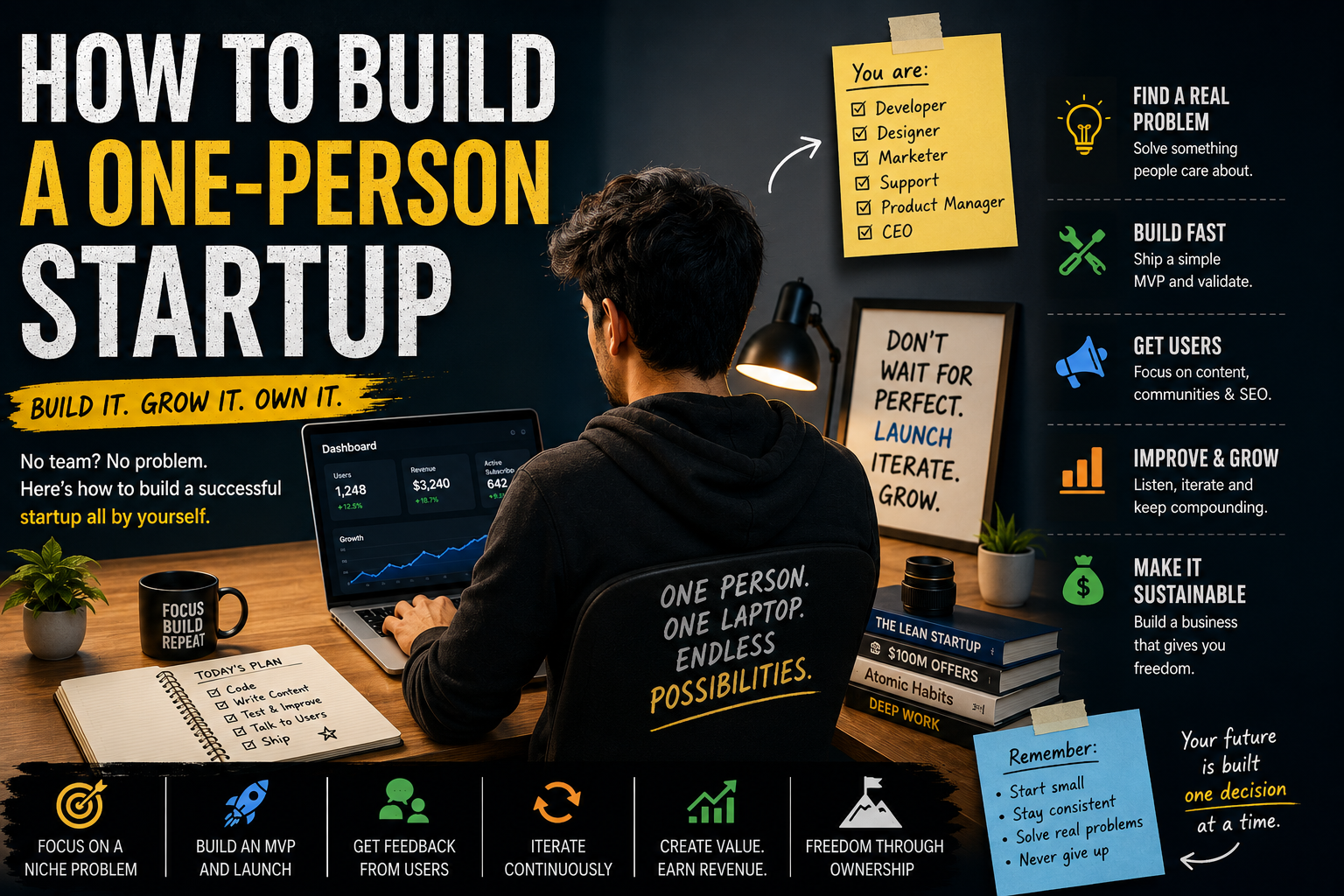
As a solo founder, you suddenly become:
- developer
- designer
- marketer
- support agent
- content creator
- SEO learner
- tester
- product manager
And switching between these roles mentally drains you.
I remember spending hours building a feature I felt proud of… then realizing nobody would even discover the product because I hadn’t thought about distribution at all.
That moment hit hard.
Most beginner founders focus only on building.
Very few focus on getting users.
And honestly, loneliness becomes another challenge.
When you work alone, there’s no team hype.
No office energy.
No meetings pushing deadlines.
If you lose discipline, progress disappears quickly.
There were weeks where I felt highly motivated and productive.
Then suddenly phases came where:
- traffic stayed zero
- ideas felt stupid
- projects looked useless
- motivation disappeared
That emotional inconsistency is part of solo building.
Nobody escapes it fully.
The Biggest Misunderstanding About Solo Startups
Many beginners think:
“One-person startup means doing everything alone forever.”
Not true.
It simply means starting lean.
A one-person startup is mostly about:
- simplicity
- speed
- ownership
- focused execution
You’re not trying to build the next Amazon immediately.
You’re trying to solve one useful problem properly.
That mindset matters a lot.
Because beginners usually overcomplicate everything.
They imagine:
- massive apps
- huge AI systems
- complex architectures
- giant marketplaces
And then they burn out before launch.
The internet rewards simplicity far more than beginners realize.
What Kind of One-Person Startup Should You Build?
This question matters more than people think.
Because not every startup idea is suitable for solo founders.
Some ideas require:
- funding
- large operations
- legal complexity
- heavy support teams
Avoid those initially.
The best one-person startups usually have these qualities:
- focused niche
- clear problem
- manageable scope
- low operational complexity
- digital delivery
Examples:
- niche SaaS
- educational platforms
- directory websites
- automation tools
- productivity systems
- AI workflow tools
- content businesses
- developer tools
Simple is powerful.
Boring can even be profitable.
That realization changed my thinking completely.
Biggest Mistakes I Made
Trying to Build Too Big Too Early
This mistake destroyed months of progress for me.
I used to think:
“If I’m building a startup, it should feel huge.”
So naturally I kept adding:
- dashboards
- admin systems
- notifications
- AI features
- analytics
- multiple user roles
Completely unnecessary.
The product became overwhelming before launch itself.
Now I think differently.
A startup should begin embarrassingly small.
One useful workflow is enough initially.
That lesson saved massive time later.
Focusing Too Much on Product and Ignoring Distribution
This is probably the most common developer mistake.
We love coding.
Users don’t care about our code.
They care about solving problems.
You can build amazing software and still fail because nobody discovers it.
That realization hurts.
I learned slowly that:
- SEO matters
- content matters
- branding matters
- trust matters
- consistency matters
A one-person startup is not only software development.
It’s audience building too.
Waiting for Motivation
Huge mistake.
Motivation is unreliable.
Some days you feel unstoppable.
Other days even opening VS Code feels exhausting.
If your startup depends only on motivation, progress becomes inconsistent.
Systems matter more.
Routine matters more.
Discipline matters more.
That’s boring advice… but painfully true.
The Real Daily Workflow of a Solo Founder
People imagine solo founders coding all day.
Reality is chaotic.
A typical day can look like:
- fixing bugs
- replying to users
- writing content
- checking analytics
- updating SEO
- debugging deployment issues
- researching competitors
- testing features
- posting on social media
Context switching becomes exhausting.
One thing that helped me massively was separating tasks.
For example:
- mornings for coding
- afternoons for content
- evenings for research or planning
Without structure, your brain feels overloaded constantly.
How to Actually Build a One-Person Startup
This is the practical part I wish someone had explained earlier.
Step 1: Choose a Problem You Understand
Don’t randomly chase trends.
Build around problems you deeply understand.
This matters because:
- decision-making becomes easier
- user understanding improves
- communication feels natural
- motivation stays stronger
For example:
- students solving educational confusion
- developers solving workflow pain
- creators solving content problems
Your environment already contains startup opportunities.
Pay attention to frustrations around you.
Step 2: Start With the Simplest Possible MVP
This lesson took me too long to learn.
You do NOT need:
- complex backend architecture
- perfect UI
- mobile apps immediately
- advanced AI systems
You need one useful solution.
That’s it.
Many beginners never launch because they overbuild endlessly.
Launch ugly if needed.
Real feedback matters more than polished assumptions.
Step 3: Focus on Distribution Early
Please understand this early.
Traffic is not automatic.
Users do not magically appear.
You need distribution channels:
- SEO
- Twitter/X
- YouTube
- communities
- blogs
- referrals
This is why content creation helps founders massively now.
Content builds trust before people even use your product.
Step 4: Keep Operational Complexity Low
Avoid ideas requiring:
- large customer support
- manual coordination
- heavy logistics
- complicated onboarding
Solo founders need simplicity.
Every additional operational task consumes mental energy.
And mental energy becomes your most valuable resource.
Step 5: Learn to Ship Fast
Perfectionism kills solo founders.
I’ve wasted ridiculous amounts of time tweaking tiny UI details nobody cared about.
Users care more about usefulness than pixel perfection.
Ship faster.
Learn faster.
Improve faster.
That cycle matters more than perfect planning.
Common Beginner Mistakes in One-Person Startups
Trying to Copy Big Startups
Beginners often imitate companies with:
- massive funding
- full teams
- dedicated departments
Bad idea.
Your advantage as solo founder is speed and focus.
Not scale initially.
Building Without Talking to Users
This mistake feels harmless initially.
It’s not.
Your assumptions are usually incomplete.
Real users reveal:
- pain points
- confusing workflows
- missing priorities
- emotional frustrations
User conversations save months.
Quitting Too Early
This one is painful.
Many projects die before they even get enough time.
People expect:
- instant traffic
- instant users
- instant revenue
Real growth is slower.
Especially for bootstrapped solo startups.
Patience becomes part of the game.
The Emotional Side of Building Alone
This part deserves more honesty.
Solo building can feel lonely.
There’s nobody constantly validating your progress.
No manager.
No teammates.
No office conversations.
Sometimes you question whether your work even matters.
Especially during low-growth phases.
I’ve had moments where:
- analytics showed almost no traffic
- launches got ignored
- projects felt pointless
And honestly, social media worsens this because everyone posts success stories only.
You rarely see:
- abandoned products
- failed experiments
- burnout
- self-doubt
But these things are extremely common.
That’s why emotional resilience matters more than beginners realize.
The ability to continue despite uncertainty becomes a superpower.
What I Learned About Sustainable Solo Startups
Over time, a few lessons became very clear.
Simplicity Wins
Complex startups sound impressive.
Simple startups survive longer.
Every additional feature creates:
- maintenance
- bugs
- complexity
- decision fatigue
Simple focused products are easier to grow.
Consistency Beats Intensity
One productive week means nothing if followed by three inactive weeks.
Small consistent progress compounds.
That applies to:
- coding
- SEO
- content
- product updates
- marketing
Consistency looks boring from outside.
But it creates momentum.
Audience Building Matters Massively
This realization changed my approach completely.
If nobody knows you exist, growth becomes painfully difficult.
Now I think founders should build:
- products
AND - audience simultaneously
Both support each other.
Money Pressure Changes Everything
This is important and rarely discussed honestly.
Building becomes emotionally harder when financial pressure increases.
That’s why many solo founders fail not because their ideas are bad… but because they run out of time or money.
This is why keeping expenses low matters initially.
Freedom creates better decision-making.
Practical Example: A Realistic Solo Startup Approach
Let’s say you’re a developer interested in education problems.
Instead of building a giant AI learning platform immediately, you could start with:
- searchable institute database
- simple comparison system
- review platform
- study material organization tool
One focused workflow.
Then gradually expand based on user feedback.
This approach reduces:
- overwhelm
- complexity
- wasted development time
And increases chances of actually launching.
Launching matters more than dreaming.
Future of One-Person Startups
Honestly, I think solo startups will grow massively over the next few years.
AI tools are reducing development barriers quickly.
One person can now:
- code faster
- design faster
- write content faster
- automate workflows faster
But interestingly…
As building becomes easier, understanding users becomes more valuable.
Execution alone won’t be enough.
The winners will be people who deeply understand:
- user frustrations
- distribution
- trust
- storytelling
- niche communities
Technology changes fast.
Human behavior changes slowly.
That’s why problem understanding remains timeless.
Real Advice I Wish Someone Told Me Earlier
Don’t wait to “feel ready.”
You probably never fully will.
Start smaller than your ego wants.
Seriously.
Most successful projects begin much simpler than people imagine.
Another important thing…
Stop romanticizing hustle culture.
Working 18 hours daily sounds impressive online.
It destroys sustainability.
Burnout quietly kills creativity.
Take care of:
- sleep
- focus
- energy
- mental clarity
Because as solo founder, you are the entire system.
And maybe the most important lesson:
Your first startup does not need to become massively successful.
Its real job is teaching you:
- shipping
- consistency
- user psychology
- distribution
- product thinking
Those lessons compound for years.
Final Thoughts
Building a one-person startup is not easy.
Some days feel exciting.
Some days feel emotionally draining.
Some days you genuinely question whether continuing makes sense.
That’s normal.
The internet shows polished success stories but hides the messy middle phase where most real growth actually happens.
If you want to build alone successfully, focus on:
- solving real problems
- keeping things simple
- shipping consistently
- learning publicly
- staying patient
And most importantly…
Don’t build just to look like a founder online.
Build because you genuinely care about solving something meaningful.
That internal reason matters during difficult phases.
Because difficult phases always come.
