If you spend enough time in startup communities, you’ll notice something funny.
Most beginners think startups use:
- insanely complex systems
- secret Silicon Valley tech
- ultra-advanced infrastructure
But honestly?
A lot of successful startups use surprisingly simple tools.
The real difference usually isn’t:
“Which framework are they using?”
It’s:
- speed
- execution
- iteration
- workflow efficiency
A small startup team survives by moving fast.
And the tools they choose directly affect that speed.
I learned this while working on startup projects myself.
Initially I wasted ridiculous amounts of time:
- switching frameworks
- chasing trendy tools
- rebuilding setups constantly
Meanwhile smarter founders were just:
- shipping products
- collecting feedback
- improving systems gradually
That realization changed how I look at developer tools completely.
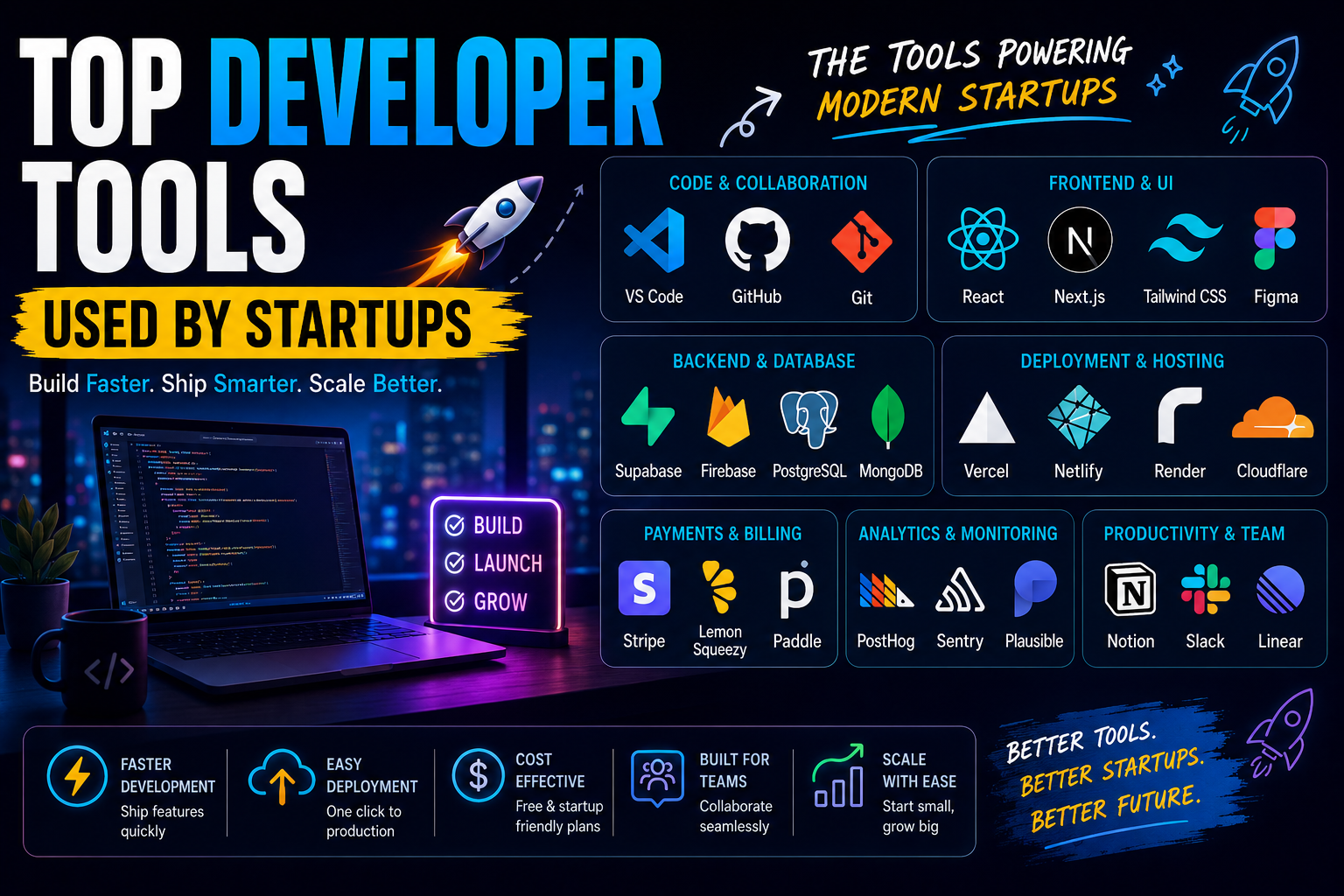
In this article, I’ll explain the top developer tools used by startups, deeply and practically — not just generic “best tools” lists.
We’ll cover:
- coding tools
- deployment platforms
- backend services
- collaboration software
- AI tools
- startup workflows
- real advantages
- mistakes founders make
Let’s start from the beginning.
Why Startup Tools Matter So Much
Large companies and startups operate very differently.
Big companies optimize for:
- stability
- process
- long-term infrastructure
Startups optimize for:
- speed
- experimentation
- survival
Huge difference.
A startup may need to:
- launch MVP quickly
- test features fast
- pivot rapidly
- manage tiny teams
So tools that:
- reduce complexity
- speed development
- simplify deployment
become extremely valuable.
My Experience With Startup Tool Chaos
Honestly…
early on I kept making one massive mistake:
I kept rebuilding my stack instead of building products.
One week:
- MERN stack
Next week:
- Firebase
Then:
- Supabase
Then:
- microservices obsession
Nothing shipped consistently.
Eventually I realized:
The best startup stack is often the one you can execute with fastest.
That lesson saved me months of wasted time.
What Makes a Tool “Startup Friendly”?
This is important.
A good startup tool usually has:
- easy setup
- fast deployment
- scalability
- generous free tier
- strong community
- low maintenance
Because startups cannot waste weeks configuring infrastructure endlessly.
Speed matters heavily.
1. Visual Studio Code
This is probably the most commonly used code editor among startups today.
And honestly…
it makes sense.
Why startups love it:
- lightweight
- huge extension ecosystem
- Git integration
- AI integrations
- multi-language support
It works for:
- frontend
- backend
- AI/ML
- DevOps
- startup founders learning code
Very flexible.
Why VS Code Became Dominant
Because it balances:
- simplicity
- power
- customization
better than most editors.
And in startups:
- onboarding speed matters
VS Code helps there heavily.
2. GitHub
Honestly impossible to ignore.
GitHub is basically startup infrastructure now.
Used for:
- code hosting
- collaboration
- CI/CD
- open-source
- issue tracking
And startup hiring often checks GitHub activity too.
What I Learned About GitHub
Initially I treated GitHub like:
“just backup storage.”
Big misunderstanding.
Over time I realized:
GitHub is more like:
- collaboration engine
- developer portfolio
- automation platform
all combined.
3. Vercel
This platform became insanely popular among startups.
Especially:
- React
- Next.js
- frontend-heavy startups
Deployment feels almost magical.
Push code →
site goes live.
That simplicity matters massively for small teams.
Why Startups Love Vercel
Because developers want to:
- build features
NOT - fight infrastructure constantly.
Vercel reduces deployment friction heavily.
4. Supabase
Supabase exploded in popularity for a reason.
It combines:
- database
- authentication
- APIs
- realtime features
- storage
in one platform.
Perfect for:
- MVPs
- SaaS products
- startup dashboards
My Thoughts on Supabase
Honestly?
This tool changed backend development speed massively for indie developers and startups.
Instead of building:
- auth manually
- APIs manually
- database systems manually
you move much faster.
5. Firebase
Still hugely popular.
Especially among:
- mobile startups
- MVP builders
- beginner founders
Firebase simplifies:
- auth
- hosting
- notifications
- realtime databases
Very beginner-friendly.
Firebase vs Supabase
This debate appears everywhere now.
Simple answer:
- Firebase = easier initially
- Supabase = more SQL-friendly and open
Both are useful.
Don’t overthink endlessly.
6. Figma
Honestly one of the most important startup tools today.
Used for:
- UI design
- wireframes
- product flows
- collaboration
The biggest advantage?
Everyone collaborates together.
Designers.
Developers.
Founders.
Huge workflow improvement.
Startup Design Reality
Many founders initially ignore design.
Bad idea.
Even technically strong products fail if:
- confusing
- ugly
- frustrating
User experience matters massively.
7. Notion
Almost every startup uses Notion somehow.
Why?
Because startups constantly need:
- documentation
- roadmaps
- planning
- team organization
Notion became:
startup operating system.
Honestly feels true sometimes.
8. Slack
Still dominant for startup communication.
Useful for:
- team chats
- integrations
- alerts
- collaboration
Though honestly…
too many Slack notifications can become exhausting quickly.
9. ChatGPT
AI tools are now deeply integrated into startup workflows.
Startups use ChatGPT for:
- debugging
- content
- brainstorming
- customer support drafts
- code assistance
- documentation
Massive productivity multiplier when used correctly.
Biggest AI Mistake Startups Make
Thinking AI replaces:
- product thinking
- engineering judgment
- customer understanding
It doesn’t.
AI accelerates workflows.
It doesn’t magically create successful products automatically.
10. GitHub Copilot
Very popular among developers now.
Especially useful for:
- repetitive coding
- boilerplate
- autocomplete
- refactoring
Saves surprising amounts of time.
11. Stripe
This tool became startup favorite because:
- APIs are excellent
- documentation is clean
- integration is developer-friendly
Many developers genuinely love Stripe docs.
Which is rare for payment systems honestly.
12. PostHog
Very underrated startup tool.
Used for:
- analytics
- feature tracking
- user behavior
- product insights
Startups need data fast.
PostHog helps there.
Why Analytics Matter More Than People Think
Founders often assume:
“Users will tell us what’s wrong.”
Usually they don’t.
Analytics reveal:
- drop-off points
- user behavior
- friction areas
Extremely valuable.
13. Linear
Many modern startups prefer Linear for issue tracking.
Why?
- fast
- clean
- minimal
- developer-focused
Feels smoother than many traditional project tools.
14. Docker
Not every startup uses Docker immediately…
but eventually many do.
Especially when:
- deployments grow
- environments become inconsistent
- scaling becomes serious
Docker solves:
“works on my machine” problems.
Huge benefit.
15. Cloudflare
Massively useful for:
- CDN
- DNS
- security
- caching
- performance
Many startups underestimate infrastructure optimization initially.
Until traffic grows.
What Startup Founders Usually Overcomplicate
This part matters.
Founders often obsess over:
- frameworks
- architecture
- trending tech
before validating product-market fit.
Huge mistake.
Most successful startups initially focus more on:
- shipping
- learning
- improving
than perfect engineering elegance.
Mistakes I Made With Startup Tools
Definitely many.
1. Tool Hopping Constantly
Very common founder problem.
Every week:
- new stack
- new backend
- new framework
No consistency.
2. Overengineering Too Early
Trying to build:
- enterprise architecture
- advanced DevOps
- microservices
before users even existed.
3. Ignoring Simplicity
Simple systems often move faster.
Complexity slows startups heavily.
4. Copying Big Tech Companies
Your startup does NOT need:
- Netflix architecture
- Google-scale systems
on Day 1.
5. Chasing Trends Instead of Shipping
This is probably the biggest one honestly.
What I Learned About Startup Development
One important realization:
Startups win more often through:
- speed
- consistency
- iteration
than perfect technology choices.
Obviously tools matter…
but execution matters more.
Always.
Best Startup Stack for Beginners
If someone asked me:
“What startup stack should I use today?”
I’d probably recommend something like:
Frontend
- React
- Tailwind CSS
Backend
- Supabase or Node.js
Hosting
- Vercel
Database
- PostgreSQL
Payments
- Stripe
Design
- Figma
Simple.
Modern.
Fast to execute.
Why Simplicity Wins Early
Because startup founders already deal with:
- stress
- uncertainty
- bugs
- customer feedback
- marketing
- funding pressure
Overly complex infrastructure only increases friction.
Simple systems create speed.
Real Advice for Developers Building Startups
Don’t spend:
- 6 months choosing stack
- 4 months optimizing architecture
- endless time watching “best framework” videos
Instead:
- pick reasonable tools
- build MVP
- get users
- improve gradually
That’s how real learning happens.
The Future of Startup Developer Tools
Honestly?
The future looks increasingly:
- AI-assisted
- cloud-native
- low-code accelerated
- automation-heavy
Startups will likely build products faster than ever before.
One skilled founder today can achieve things that previously required entire teams.
That’s exciting.
Final Thoughts
The best startup tools are not necessarily:
- the most advanced
- the most hyped
- the most complicated
They’re usually the tools that:
- reduce friction
- increase speed
- simplify workflows
- help teams execute consistently
And honestly…
many successful startups are built using surprisingly boring, practical tools.
Because at the end of the day:
users care more about solving problems than your fancy stack.
Always remember that.
