Building something on the internet sounds exciting… until you actually sit down and try to decide what to build.
I still remember opening my laptop at 2 AM, staring at a blank Notion page, typing random startup ideas while watching YouTube videos about “how to build a million-dollar SaaS.” One video said SaaS is the future. Another guy on Twitter was making money with mobile apps. Then some developer on Reddit casually mentioned his content website was earning more than his software products.
At that moment, honestly, I got confused.
Should I build a SaaS product?
Should I launch an app?
Should I just make a website and grow traffic?
And this confusion is very normal. Almost every beginner developer, indie hacker, or startup founder goes through this phase. Especially when you start learning web development or programming, you suddenly see thousands of possibilities and zero clarity.
The worst part? People online make everything look easy.
“Just build a SaaS.”
“Apps make passive income.”
“Start a blog.”
“Launch AI tools.”
“Make micro-products.”
Bhai… reality itni simple nahi hoti.
Because every product type has different problems, different business models, different technical headaches, different marketing struggles, and completely different user expectations.
I learned this the hard way.
So in this article, I’m not going to give textbook definitions only. I want to explain this like a real developer/founder who has wasted time, switched ideas, rebuilt projects from scratch, struggled with traffic, handled user complaints, and realized that choosing the wrong type of product can destroy your motivation very quickly.
If you’re confused between building a SaaS, an app, or a website… this article might genuinely save you months of confusion.
Why This Topic Matters More Than Beginners Think
Most people think the difficult part is coding.
It’s not.
The difficult part is building the right thing for your goals, skills, time, and patience level.
I’ve seen developers spend 8 months building complex SaaS dashboards with authentication, subscriptions, APIs, analytics, admin panels… only to realize nobody needed the product.
At the same time, I’ve seen simple niche websites earn decent money through ads and affiliate marketing with far less technical stress.
Then there are mobile apps. Apps look cool from outside. But app development comes with its own pain — Play Store issues, app retention problems, notification handling, crashes on different devices, low downloads, terrible reviews after one tiny bug… and trust me, users on mobile are very unforgiving.
The problem is beginners usually choose based on hype instead of reality.
That’s where mistakes begin.
First Understand the Real Difference
A lot of people use these words interchangeably. But SaaS, app, and website are not the same thing.
And understanding the difference properly changes how you think as a builder.
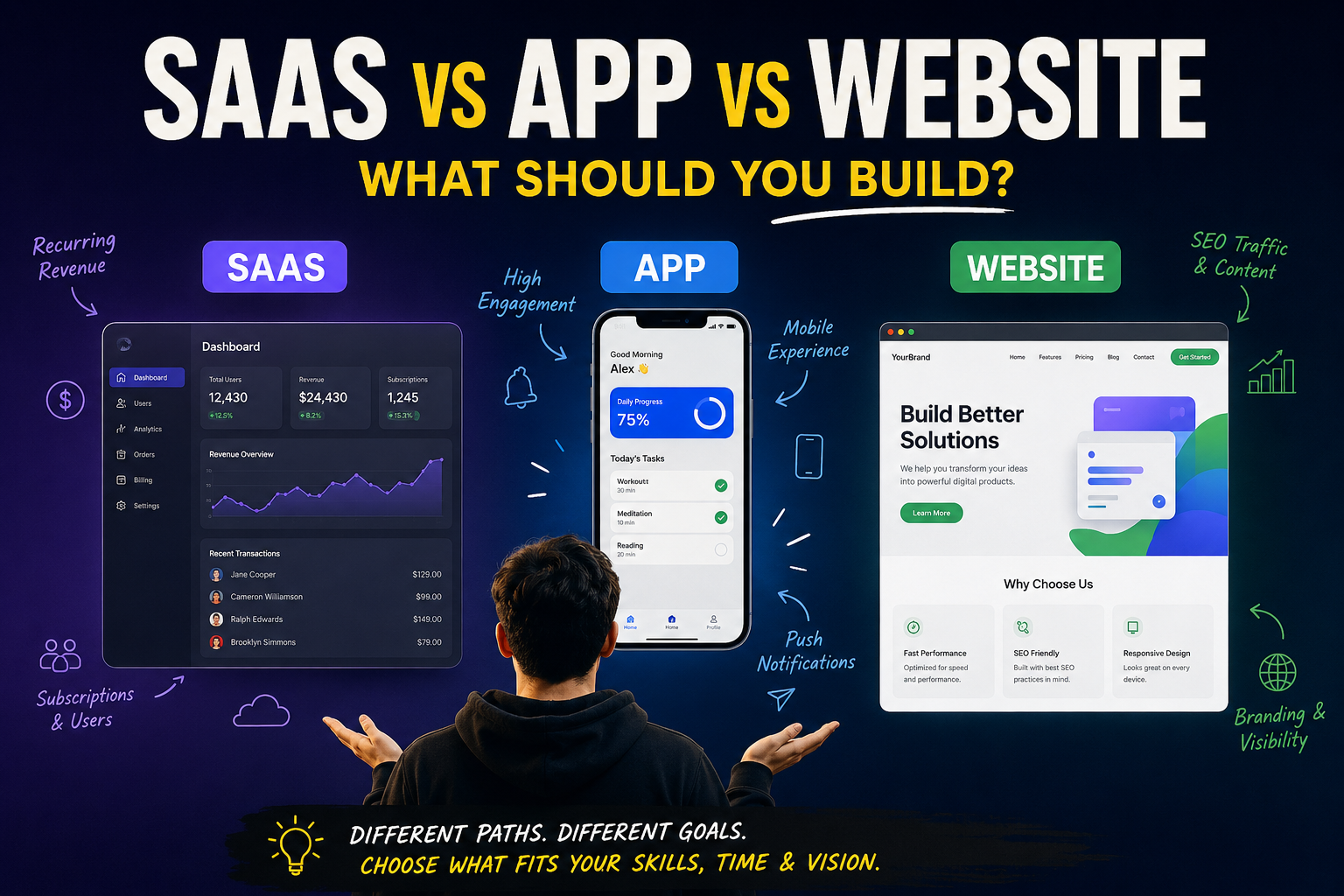
What is a Website?
A website is mainly informational or content-focused.
People visit, consume content, maybe contact you, maybe buy something, and leave.
Examples:
- Blogs
- Portfolio sites
- News websites
- Educational platforms
- Company websites
- Directory websites
- Landing pages
A website usually works through browsers and focuses heavily on content, SEO, discoverability, or information.
For example, a tech blog like Ashbyte.in is a website.
A coaching discovery platform can also start as a website.
The main focus is often:
- traffic
- content
- visibility
- trust
- discoverability
Websites are honestly one of the best starting points for beginners because they teach:
- frontend
- backend basics
- SEO
- hosting
- performance
- analytics
- user behavior
And they are easier to maintain compared to SaaS products.
But websites also have one brutal problem:
Traffic takes time.
Sometimes months.
Sometimes a year.
This is where many beginners quit.
What is an App?
Now apps are different because they are usually built for repeated usage and convenience.
Apps live on phones, tablets, or desktops.
Examples:
- Spotify
- Habit trackers
- Food delivery apps
- Fitness apps
- Note-taking apps
Apps focus more on:
- user engagement
- retention
- notifications
- smooth experience
- accessibility
The emotional attachment users develop with apps is very strong compared to websites.
But building apps is harder than YouTube tutorials make it look.
You’re not just coding screens.
You’re handling:
- responsiveness
- device compatibility
- performance
- app store optimization
- permissions
- battery optimization
- updates
- crashes
- user retention
And mobile users uninstall apps very fast.
Seriously. One laggy screen and people delete your app without mercy.
I learned this after testing a student-focused app idea. We thought users would love it. But after launch, retention dropped badly because students simply didn’t want another app taking storage space.
That was painful to realize.
What is SaaS?
SaaS means Software as a Service.
This is where things become more business-oriented.
A SaaS product solves a recurring problem and usually charges users monthly or yearly.
Examples:
- Notion
- Canva
- Slack
- Shopify
- Grammarly
- Trello
SaaS products are not just “websites with login.”
That’s the biggest beginner misunderstanding.
A real SaaS product involves:
- authentication
- subscriptions
- recurring billing
- user dashboards
- databases
- permissions
- customer support
- onboarding
- analytics
- scaling infrastructure
And once people pay you monthly, expectations become very high.
This is something nobody tells beginners.
Free users tolerate bugs.
Paying users do not.
The moment someone gives you ₹499/month or $20/month, they expect professionalism immediately.
Suddenly your side project becomes responsibility.
My Experience: The Biggest Confusion Phase of My Journey
When I first started building projects seriously, I was obsessed with creating a startup.
Every beginner founder goes through this phase where they think:
“I need to build something huge.”
So naturally, I jumped toward SaaS ideas first.
Because SaaS looked “successful.”
Twitter founders were posting MRR screenshots.
YouTube creators were talking about recurring revenue.
Everywhere people were saying:
“Build SaaS, escape 9–5.”
Sounds exciting.
Reality was different.
My first SaaS attempt became a disaster because I focused more on features than users.
I spent weeks building:
- dashboards
- authentication
- admin systems
- fancy UI
- analytics
But I never validated whether people actually needed the product.
Classic beginner mistake.
Then I switched toward content websites and honestly… that taught me more practical lessons than SaaS initially did.
Because websites force you to understand:
- user intent
- SEO
- consistency
- content psychology
- patience
Traffic growth teaches humility very quickly.
You publish articles and expect instant visitors.
Nothing happens.
Then slowly one article ranks.
Then another.
Then maybe some impressions appear.
And suddenly you realize internet businesses are not built overnight.
That realization changed my mindset completely.
Biggest Mistakes I Made
1. Choosing Based on Hype
This is probably the most dangerous mistake.
I chose SaaS because it sounded impressive.
Not because it matched my skills or resources.
Many beginners do this.
They see:
- AI SaaS
- startup culture
- funding stories
- indie hacker tweets
And they think:
“I should build SaaS too.”
But nobody talks about the boring parts:
- support emails
- churn
- failed onboarding
- payment issues
- server costs
- feature requests
Those things become mentally exhausting.
2. Ignoring Distribution
This one hurt badly.
I believed:
“If the product is good, users will come.”
Absolutely wrong.
You can build the best app or SaaS in the world and still fail because nobody knows it exists.
Distribution matters more than beginners realize.
Traffic.
SEO.
Social media.
Communities.
Content.
Word of mouth.
Without these, products die silently.
This is why websites can actually become powerful starting points. Content compounds slowly over time.
3. Building Too Much Too Early
I used to overbuild everything.
Before launch:
- dark mode
- admin panel
- analytics
- notifications
- multiple dashboards
- complex APIs
Completely unnecessary.
Users don’t care about your architecture initially.
They care about solving their problem.
That’s it.
Now whenever I build something, I ask:
“What is the minimum useful version?”
That question saves massive time.
SaaS vs App vs Website: Which One is Easier?
Honestly?
Websites are usually easiest to start.
Apps are moderate difficulty.
SaaS is hardest.
But difficulty also depends on your goals.
Let me explain practically.
If You Build a Website
You mainly focus on:
- content
- SEO
- UI
- speed
- traffic
Monetization can happen through:
- ads
- affiliate marketing
- sponsorships
- lead generation
- digital products
Websites are amazing for:
- learning
- branding
- organic growth
- audience building
The downside?
Growth can feel painfully slow initially.
There were moments when I published article after article and literally nobody visited.
That phase tests your consistency heavily.
But once traffic starts compounding, websites become very powerful assets.
If You Build an App
Apps are good when:
- users need frequent access
- notifications matter
- convenience matters
- mobile experience is important
Examples:
- productivity apps
- social platforms
- fitness tracking
- chat systems
But app growth is difficult now.
The app market is overcrowded.
People install fewer apps than before.
You need strong retention.
And honestly… marketing apps is harder than coding them sometimes.
If You Build SaaS
SaaS is powerful because recurring revenue changes everything.
One paying customer can generate income every month.
That’s exciting.
But SaaS also demands:
- reliability
- support
- continuous updates
- trust
You’re building software and running a business simultaneously.
This dual pressure burns out many developers.
Especially solo founders.
I’ve experienced phases where coding wasn’t even the hardest part anymore. Managing users mentally became harder.
Common Beginner Mistakes
Trying to Build “The Next Big Thing”
Beginners think too big too early.
“AI-powered social network for students.”
“Next LinkedIn.”
“Next YouTube.”
Relax.
Start smaller.
Small useful products teach more than giant unfinished dreams.
Copying Trends Blindly
One month everyone builds AI wrappers.
Next month everyone builds productivity apps.
Most trend-following projects disappear quickly because builders chase hype instead of solving problems.
Build around pain points.
Not trends.
Ignoring Monetization Reality
A website with traffic but no monetization plan struggles.
A SaaS with no paying users struggles.
An app with no retention struggles.
You must understand:
“How will this survive?”
Not immediately maybe… but eventually.
Real-World Scenarios: What Should You Actually Build?
Scenario 1: You’re a Beginner Developer
Build a website first.
Seriously.
A website teaches:
- frontend
- backend
- deployment
- databases
- SEO
- analytics
And you can launch quickly.
You gain confidence faster.
Scenario 2: You Want Passive Traffic
Choose content websites or niche platforms.
This works well for:
- blogs
- directories
- educational sites
- tools
SEO traffic compounds over time.
But patience is mandatory.
Scenario 3: You Want Monthly Revenue
SaaS makes more sense.
But only if:
- the problem is recurring
- users genuinely need the solution regularly
- you can provide support consistently
Don’t jump into SaaS just because recurring revenue sounds attractive.
Recurring responsibility also comes with it.
Scenario 4: Your Idea Depends on Mobile Usage
Build an app.
Examples:
- habit trackers
- social interactions
- fitness monitoring
- notifications
- location-based services
Apps work best when mobile experience is central to the product.
Step-by-Step: How I’d Decide Today
If I had to start again from zero, here’s honestly how I’d think.
Step 1: Identify the Problem First
Not the technology.
Not the startup category.
The problem.
Ask:
- Who has this problem?
- How painful is it?
- How often does it happen?
- Are people already paying for solutions?
This changes everything.
Step 2: Validate Before Building
This lesson took me too long to learn.
Talk to people first.
Post in communities.
Ask questions.
Observe complaints.
Read Reddit discussions.
Study competitors.
Validation before coding saves months.
Step 3: Start Small
Don’t build the complete vision initially.
Build:
- one feature
- one workflow
- one useful solution
That’s enough.
Many successful startups started embarrassingly simple.
Step 4: Choose Based on Your Strength
If you enjoy writing and SEO:
Build websites.
If you enjoy product systems:
Build SaaS.
If you enjoy mobile experiences:
Build apps.
Your personality matters more than people think.
The Emotional Side Nobody Talks About
This part matters a lot.
Building products emotionally affects you.
Especially solo developers.
There are days when:
- traffic drops
- users complain
- revenue stays zero
- bugs appear randomly
- motivation disappears
And social media makes everything worse because everyone posts success screenshots only.
Nobody posts:
- failed launches
- abandoned projects
- burnout
- frustration
- confusion
I’ve had projects where I spent weeks coding and later realized nobody cared.
That feeling hurts.
But honestly… those failures teach more than successful projects sometimes.
You start understanding users better.
You stop romanticizing startup culture.
You become more practical.
That shift is important.
What I Learned After Building Different Types of Projects
One lesson became very clear over time:
There is no universally “best” choice.
The right choice depends on:
- your goals
- your patience
- your strengths
- your resources
- your lifestyle
A website can outperform a SaaS financially.
A simple app can go viral unexpectedly.
A SaaS can fail despite amazing code.
Internet business is unpredictable.
Which is why execution consistency matters more than idea perfection.
Future Perspective: Where Things Are Going
Right now, AI is changing everything.
People are building:
- AI SaaS products
- AI apps
- AI-powered websites
- automation tools
But interestingly, the core fundamentals still remain same.
Users still care about:
- solving problems
- saving time
- convenience
- trust
- clarity
Technology changes.
Human behavior changes slowly.
That’s why even simple well-executed products still win.
Real Advice I Wish Someone Told Me Earlier
Don’t wait for the perfect idea.
Seriously.
Most beginners waste years “thinking.”
Build small things.
Ship fast.
Learn publicly.
Improve continuously.
Your first project probably won’t succeed massively.
That’s okay.
Its real job is teaching you:
- workflows
- deployment
- debugging
- user psychology
- consistency
Those lessons compound over time.
Another important thing…
Stop comparing your beginning with someone’s 10-year journey online.
That comparison destroys creativity.
Focus Here:
If you’re still confused between SaaS vs app vs website, here’s the simplest truth I can give you after all my confusion and experimentation:
A website is usually the best place to start.
It teaches fundamentals.
It builds confidence.
It helps you understand users and traffic.
Then gradually you can move toward apps or SaaS once you understand real user problems better.
Many people try starting from complicated SaaS products immediately and burn out.
You don’t need to build the next unicorn startup right now.
You just need to build something useful.
That mindset shift changes everything.
And honestly… sometimes the simplest projects become the most successful because they actually solve real problems instead of chasing hype.
So stop overthinking too much.
Pick one small idea.
Launch it.
Learn from it.
Improve.
Repeat.
That’s how real builders grow.
Not through endless planning.
Through shipping.
