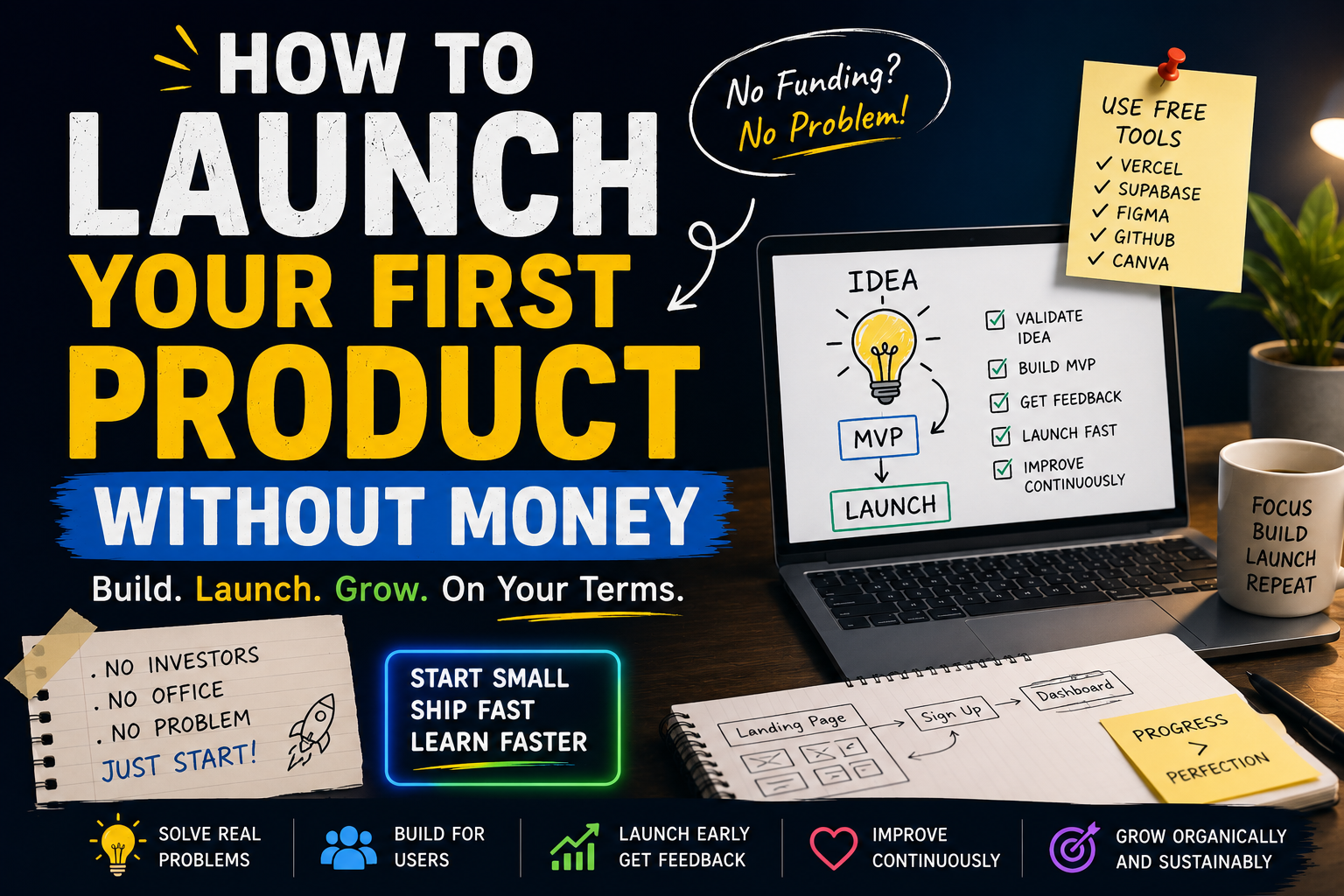
A lot of people think startups begin with:
- funding
- investors
- expensive offices
- paid teams
- huge marketing budgets
But honestly?
Many real products start with:
- one laptop
- late-night work
- confusion
- free tools
- and someone stubborn enough to keep going.
I realized this while trying to build projects myself.
Initially I used to think:
“I’ll start properly once I have money.”
Sounds logical, right?
But that mindset quietly delays execution forever.
Because the truth is:
if you keep waiting for:
- perfect funding
- perfect timing
- perfect skills
- perfect confidence
you may never launch anything.
And the interesting part is…
today’s internet makes it surprisingly possible to launch your first product with almost zero investment.
Not easy.
But possible.
In this article, I’ll explain the real process of launching your first product without money, deeply and practically — from a developer/founder perspective.
Not fake “become millionaire in 30 days” startup content.
Real process.
Real struggles.
Real lessons.
Let’s start.
Why Most People Never Launch Anything
This part is important.
Most people don’t fail because:
- they lack ideas
They fail because:
- they stay stuck in preparation mode.
They keep:
- watching tutorials
- planning endlessly
- researching tools
- redesigning ideas
without ever shipping something publicly.
I’ve fallen into this trap too.
At one point I had:
- startup ideas
- domain names
- Figma designs
- feature lists
but no actual launched product.
That realization honestly felt painful.
My Biggest Launch Lesson
One thing changed my mindset completely:
Launching teaches more than planning ever will.
You learn faster from:
- one real user
than: - 100 hypothetical assumptions.
That’s the real difference between builders and dreamers.
Step 1: Stop Thinking Big Initially
This is probably the biggest beginner mistake.
People try building:
- next Facebook
- next Uber
- massive AI platforms
as first product.
Bad idea honestly.
Because large ideas create:
- overwhelm
- complexity
- endless delays
Instead:
start painfully small.
What “Small Product” Actually Means
A small product can be:
- simple tool
- niche utility
- student helper
- productivity app
- API wrapper
- dashboard
- browser extension
- automation tool
Not every product needs billion-dollar ambition initially.
Sometimes small useful tools grow surprisingly well.
Real Example
Instead of:
“AI platform for education industry”
Start with:
“Simple institute comparison tool.”
Much easier to launch.
Much easier to validate.
Step 2: Solve a Real Problem
This matters more than technology.
Most failed products suffer from:
- weak problem selection
not weak coding.
Ask:
- What frustrates people repeatedly?
- What wastes time?
- What feels annoying?
- What process feels broken?
Real pain creates real demand.
My Mistake With Product Ideas
Initially I chased:
- “cool ideas”
instead of:
- useful problems.
Huge difference.
Cool ideas attract attention temporarily.
Useful products retain users.
That lesson took time to understand.
Step 3: Validate Before Building
Please don’t spend:
- 6 months coding secretly
before checking if people even care.
This mistake destroys motivation badly.
How to Validate for Free
Simple methods work:
- Reddit discussions
- LinkedIn posts
- Twitter/X conversations
- Discord communities
- WhatsApp groups
- talking to friends/users
Ask:
- Would this actually help?
- What do they currently use?
- What frustrates them most?
You’ll learn more from real conversations than endless assumptions.
Why Validation Feels Uncomfortable
Because validation risks rejection.
And honestly?
Many founders subconsciously avoid this.
Building privately feels emotionally safer.
But real feedback matters more than comfort.
Step 4: Use Free Tools Aggressively
This is where modern startups have huge advantage.
Years ago launching products required:
- expensive servers
- paid software
- infrastructure teams
Now?
One person can launch surprisingly powerful products almost free.
Best Free Tools for Beginners
Frontend
- React
- Tailwind CSS
Backend
- Supabase
- Firebase
Hosting
- Vercel
- Netlify
Design
- Figma
Coding
- Visual Studio Code
These tools are strong enough for real startup MVPs.
What Shocked Me About Modern Tools
Honestly?
The biggest limitation today is often NOT technology.
It’s:
- consistency
- execution
- focus
The tools available for free now are honestly insane compared to previous years.
Step 5: Build MVP, Not Full Startup
This step saves enormous time.
MVP means:
Minimum Viable Product
Translation:
smallest useful version solving one core problem.
Not:
- full ecosystem
- advanced analytics
- 50 features
- enterprise architecture
Beginners overbuild constantly.
My MVP Mistake
I once planned:
- AI features
- dashboards
- admin systems
- analytics
- advanced auth
before even validating core product.
Classic founder mistake honestly.
Now I ask:
“What’s the simplest useful version possible?”
That question changes everything.
Step 6: Don’t Wait for Perfect Design
This one hurts perfectionists badly.
Your first product:
- won’t look perfect
- won’t feel polished
- won’t impress everyone
Normal.
Users care more about:
- usefulness
than: - perfect animations.
What I Learned About Product Design
Good UX matters.
But “perfect aesthetic obsession” delays launches unnecessarily.
Initially:
clarity matters more than beauty.
Step 7: Learn Basic Marketing Early
This surprises technical founders.
Building product ≠ getting users.
Very different challenges.
You can build amazing software…
and still get ignored completely online.
Why Marketing Matters So Much
Internet is crowded now.
Visibility matters heavily.
Even simple products need:
- content
- SEO
- audience building
- community presence
Otherwise nobody discovers them.
My Biggest Marketing Realization
I used to think:
“Good products automatically grow.”
Sometimes yes.
Usually no.
Most successful products actively:
- market
- educate
- communicate
- share progress
consistently.
Step 8: Build in Public
This strategy is underrated for beginners.
Instead of building secretly forever:
share journey publicly.
You can post:
- progress screenshots
- lessons
- bugs
- milestones
- feature updates
People start following journey before launch.
Why This Helps So Much
You slowly build:
- trust
- visibility
- audience
- accountability
before product fully launches.
Very powerful for bootstrapped founders.
Step 9: Launch Before Feeling Ready
This is emotionally difficult.
Because launching means:
- judgment
- feedback
- criticism
- uncertainty
So founders delay endlessly.
I’ve done this too many times honestly.
Thinking:
“Just one more feature…”
Dangerous trap.
Real Startup Truth
You’ll NEVER feel fully ready.
At some point:
you just launch.
That’s reality.
Step 10: Collect Feedback Without Ego
This part matters hugely.
Many founders become emotionally attached to:
- features
- UI decisions
- workflows
But users reveal uncomfortable truths quickly.
Sometimes:
- confusing features
- unnecessary complexity
- weak onboarding
become obvious only after launch.
What I Learned About User Feedback
Feedback isn’t attack.
It’s data.
That mindset shift improves products massively.
Step 11: Focus on Retention, Not Vanity
Beginners often chase:
- likes
- followers
- hype
But real product growth depends on:
users returning consistently.
One loyal user matters more than:
100 random visitors who disappear instantly.
Real Founder Mistake
Trying to impress everyone.
Impossible.
Better approach:
solve specific problem deeply for smaller audience.
Step 12: Improve Gradually Instead of Rebuilding Constantly
This mistake destroys many projects.
Founders keep:
- switching stacks
- redesigning UI
- rebuilding architecture
instead of improving existing product.
I’ve wasted months doing this honestly.
What I Learned About Consistency
Small continuous improvements beat:
massive unfinished rebuilds.
Almost always.
Emotional Reality Nobody Talks About
Launching products emotionally affects people deeply.
You experience:
- excitement
- doubt
- fear
- comparison
- burnout sometimes
Completely normal.
Especially when:
- users don’t come immediately
- engagement feels low
- growth feels slow
Startup journeys rarely look glamorous internally.
Biggest Mistakes I Made While Launching Products
Definitely several.
1. Waiting Too Long
Fear disguised as preparation.
2. Building Too Many Features
Complexity delayed everything.
3. Ignoring Marketing Initially
Huge mistake.
4. Comparing With Big Startups
Very unhealthy mentally.
5. Thinking Money Was Main Problem
Honestly?
Execution mattered more.
What I Learned About Launching Without Money
One huge realization:
Lack of money forces:
- creativity
- efficiency
- simplicity
And surprisingly…
those constraints sometimes create better products.
Because bootstrapped founders focus harder on:
- real value
- real users
- real problems
instead of vanity features.
Real Advice for Beginner Founders
If you currently have:
- laptop
- internet
- willingness to learn
you already have enough to start building something meaningful.
Seriously.
The biggest gap is usually:
- action
not resources.
The Internet Rewards Builders Now
This is important.
Today developers can:
- build publicly
- learn free
- distribute globally
- market through content
- launch from bedroom
That opportunity is honestly incredible.
A single person can now:
- code
- design
- market
- launch
- monetize
products independently.
That wasn’t this accessible before.
The Future of Bootstrapped Startups
Honestly?
Solo founders and small teams will become even stronger because:
- AI accelerates development
- cloud tools reduce infrastructure cost
- distribution platforms exist everywhere
Execution speed matters more than ever now.
Note:
Launching your first product without money is absolutely possible today.
Not easy.
But very possible.
And honestly…
the biggest thing stopping most people usually isn’t:
- funding
- technology
- resources
It’s:
- fear of launching
- perfectionism
- endless preparation
That’s the real obstacle.
Because real products grow through:
- feedback
- iteration
- imperfect action
not perfect planning.
