Almost every developer or founder has experienced this moment.
You’re sitting somewhere randomly:
- late at night
- during college class
- while scrolling social media
- after facing a frustrating problem
and suddenly your brain says:
“Wait… this could actually become a product.”
That excitement feels amazing.
For a few minutes, your mind starts imagining:
- users
- startup growth
- app UI
- funding
- maybe even success stories
But then reality hits.
Questions appear:
- Where do I start?
- What should I build first?
- What if nobody uses it?
- How do real startups turn ideas into actual products?
Honestly?
This is where most people get stuck.
Not because they lack ideas…
but because they don’t understand the PROCESS.
I learned this the hard way while working on startup ideas and product experiments.
Initially I thought:
“Good ideas automatically become successful products.”
Completely wrong.
Execution matters far more than ideas.
And turning an idea into a real product is messy, confusing, and much more practical than motivational startup content makes it seem.
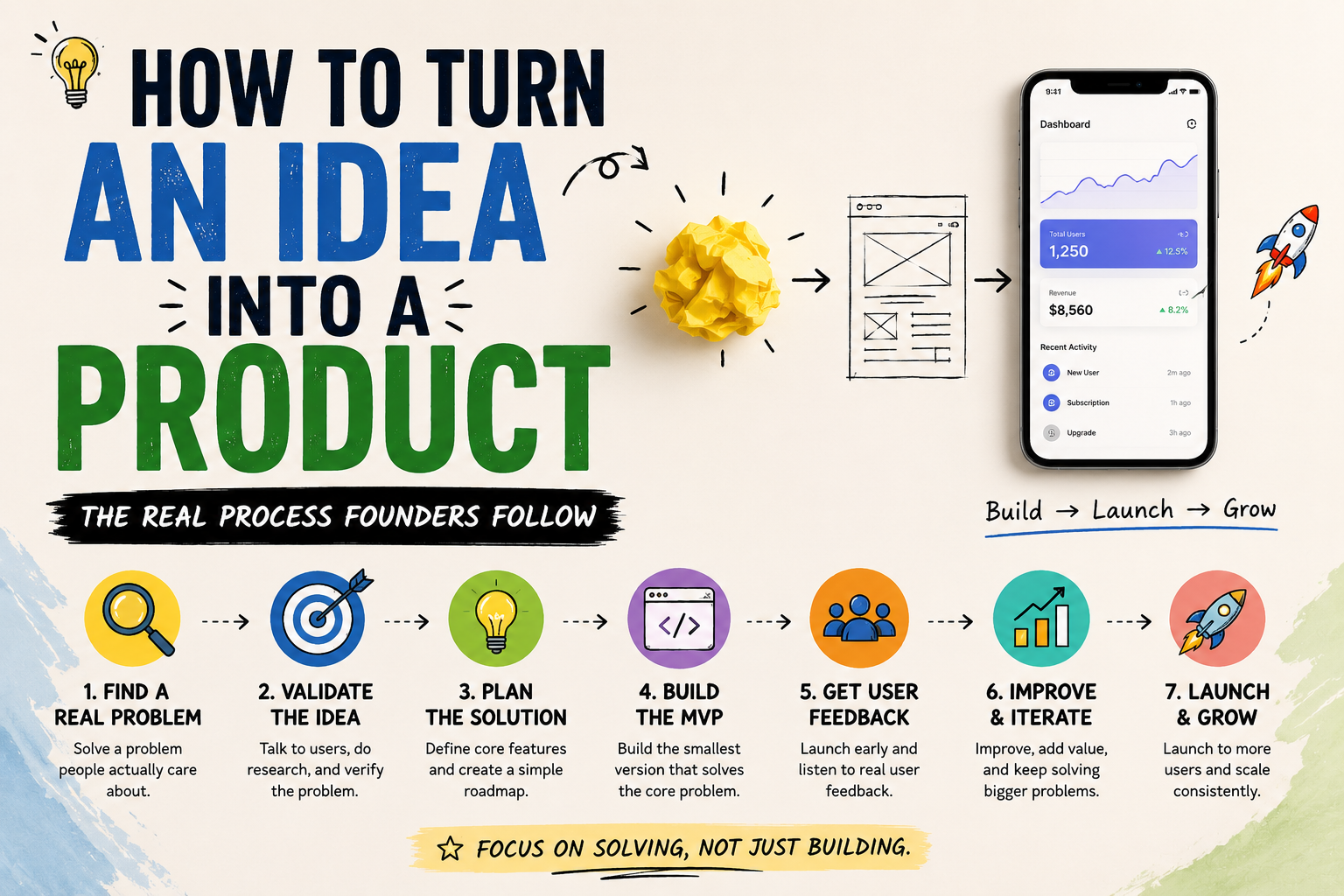
In this article, I’ll explain the real process of turning an idea into a product, deeply and honestly — from a developer/founder perspective.
Not fake “build unicorn in 30 days” advice.
Real process.
Real mistakes.
Real lessons.
Let’s start.
Most People Fall in Love With Ideas Too Early
This is probably the biggest founder mistake.
A beginner gets an idea and instantly thinks:
“This will change everything.”
I’ve done this too many times honestly.
You start:
- designing logos
- choosing startup names
- planning billion-dollar features
before even validating whether anyone actually needs the product.
Dangerous trap.
Because ideas feel exciting.
Validation feels uncomfortable.
My Biggest Startup Realization
One lesson changed my thinking completely:
Problems matter more than ideas.
Strong products usually solve:
- annoying problems
- repetitive frustrations
- expensive inefficiencies
- painful workflows
Good founders obsess over problems first.
Not features.
Step 1: Start With a Real Problem
Before writing code, ask:
“What problem am I solving?”
And more importantly:
“Who actually suffers from this problem?”
This matters massively.
Because many products fail due to:
- weak problem selection
not weak coding.
Real Example
Bad startup idea:
“AI-powered social platform for everyone.”
Too vague.
Better:
“Students struggle to compare institutes transparently in tier-2 cities.”
Specific problem.
Specific audience.
Much stronger foundation.
Why Specific Problems Win
Specific problems create:
- clearer messaging
- clearer users
- clearer product direction
Broad ideas usually become confusing products.
Step 2: Validate Before Building
This is where many founders fail.
They spend:
- 6 months coding
- designing perfect UI
- building advanced architecture
before discovering:
nobody really wants the product.
Painful situation honestly.
My Early Validation Mistake
I used to think:
“If I build it well, users will automatically come.”
Nope.
Internet is full of technically impressive products nobody uses.
That reality humbled me quickly.
How to Validate an Idea Properly
You don’t need:
- huge surveys
- expensive research
Initially simple validation works.
Talk to:
- students
- developers
- creators
- businesses
- target users
Ask:
- What frustrates them?
- What tools do they currently use?
- What annoys them most?
- Would they pay for better solution?
Real conversations reveal more than assumptions.
Step 3: Define the Smallest Possible Product (MVP)
This step is critical.
Most beginners try building:
- massive systems
- endless features
- “complete platform”
Huge mistake.
Instead build:
MVP (Minimum Viable Product)
Meaning:
smallest version solving core problem.
Example
Instead of:
- full educational ecosystem
Start with:
- simple institute comparison system
That’s much more manageable.
Why MVPs Matter So Much
Because startups need:
- feedback quickly
- learning quickly
- iteration quickly
Big products slow all three.
I once planned:
- dashboards
- analytics
- AI features
- advanced admin systems
before validating basic product need.
Classic overengineering.
Now I try asking:
“What is the smallest useful version?”
Much smarter approach.
Step 4: Choose the Right Tech Stack
This is where developers often overcomplicate things.
They spend months debating:
- React vs Vue
- SQL vs NoSQL
- microservices vs monolith
Meanwhile nothing ships.
Real Startup Truth
Most early users do NOT care whether your backend uses:
- Node.js
- Django
- Go
- Firebase
They care whether:
the product solves their problem.
That’s it.
Best Beginner Startup Stack
Honestly, simple modern stacks work great:
Frontend
- React
Styling
- Tailwind CSS
Backend
- Supabase or Firebase
Hosting
- Vercel
Simple.
Fast.
Scalable enough initially.
Step 5: Focus on User Experience Early
This part gets ignored badly by technical founders.
Many developers think:
“Functionality matters more than design.”
Partially true.
But confusing UI kills products fast.
Even strong products fail if users feel:
- lost
- confused
- frustrated
What I Learned About UX
Users don’t care how hard your backend was.
They care:
- does it feel easy?
- does it save time?
- does it feel smooth?
That emotional experience matters hugely.
Step 6: Build Fast, But Don’t Build Carelessly
This balance matters.
Some founders:
- overbuild forever
Others:
- rush terrible products publicly
Both are bad.
You want:
- speed
- clarity
- enough quality
Not perfection.
Real Founder Reality
Your first version will probably:
- look messy
- contain bugs
- feel incomplete
Normal.
Every successful startup started imperfectly.
Step 7: Launch Earlier Than Feels Comfortable
This is psychologically hard.
Because launching means:
- feedback
- criticism
- uncertainty
So founders delay endlessly.
I’ve done this too.
Thinking:
“Just one more feature…”
Dangerous cycle.
Why Early Launches Matter
Because real users reveal:
- confusing features
- broken assumptions
- missing workflows
- actual demand
Much faster than internal planning.
Step 8: Listen to Users Carefully
This is where real product building starts.
Many founders think product creation ends after launch.
Actually launch is beginning.
Now you collect:
- feedback
- complaints
- usage behavior
- confusion patterns
This data shapes real product direction.
Biggest User Feedback Mistake
Ignoring patterns.
One complaint = maybe random.
20 users complaining about same thing?
Important signal.
Step 9: Improve Based on Real Usage
This separates real startups from abandoned side projects.
Good founders:
- observe users
- iterate constantly
- simplify continuously
Product evolution never really stops.
My Product Building Mistake
I used to build features based on:
what looked impressive.
Now I ask:
“Does this actually improve user experience?”
Huge mindset difference.
Step 10: Learn Marketing Earlier
This part surprises technical founders.
Building product ≠ getting users.
Completely different challenge.
You can build amazing software…
and still get ignored.
Why Distribution Matters
Internet is crowded now.
You need:
- content
- SEO
- community
- social proof
- marketing strategy
Otherwise even strong products disappear silently.
Real Startup Lesson
Products rarely “go viral automatically.”
Most successful startups actively:
- market
- iterate
- communicate
- educate users
consistently.
Step 11: Avoid Endless Perfectionism
This one nearly trapped me multiple times.
You keep thinking:
- UI not perfect
- code not perfect
- architecture not perfect
So launch keeps getting delayed.
But honestly?
Users care far less about perfection than founders assume.
What Users Actually Want
Users mostly want:
- reliable solution
- clear experience
- saved time
- reduced frustration
Not perfect animations.
Step 12: Learn From Failed Ideas Too
This is important emotionally.
Not every product succeeds.
Normal.
Some ideas fail because:
- wrong audience
- weak problem
- poor timing
- weak distribution
Failure still teaches:
- product thinking
- systems
- execution
- market understanding
Very valuable.
Mistakes I Made Turning Ideas Into Products
Definitely many.
1. Building Too Much Before Validation
Classic founder mistake.
2. Falling in Love With Features
Features ≠ value automatically.
3. Ignoring User Experience
Technical strength alone doesn’t guarantee usability.
4. Delaying Launch Too Long
Fear disguised as “preparation.”
5. Thinking Coding Is the Hardest Part
Honestly?
Getting users is often harder.
What I Learned About Product Building
One huge realization:
Turning idea into product is less about:
genius inspiration
and more about:
- consistency
- iteration
- listening
- execution
- solving real pain
That’s the real game.
The Emotional Side Nobody Talks About
Building products emotionally affects founders too.
You experience:
- excitement
- doubt
- motivation swings
- frustration
- comparison
- burnout sometimes
Completely normal.
Startup journeys are rarely smooth.
Real Advice for Beginner Founders
Don’t wait until:
- perfect skills
- perfect funding
- perfect confidence
before building.
Because honestly…
most founders start while still figuring things out.
The key difference is:
they start anyway.
Best Modern Tools for Building Products Fast
Today founders can build products surprisingly fast using:
- Visual Studio Code
- GitHub
- Supabase
- Vercel
- Figma
- ChatGPT
The barrier to building products is lower than ever.
Execution matters more now.
The Future of Product Building
Honestly?
AI is accelerating product development massively.
Small teams can now:
- prototype faster
- design faster
- debug faster
- automate faster
But core principles still remain same:
- solve real problems
- understand users
- execute consistently
Those never change.
Final Thoughts
Most people think successful products begin with:
brilliant ideas.
But honestly…
great products usually begin with:
- real problems
- consistent execution
- continuous learning
And the process is much messier than social media startup stories make it seem.
There will be:
- confusion
- bugs
- failed ideas
- awkward launches
- uncertain moments
Completely normal.
That’s how real products are built.
