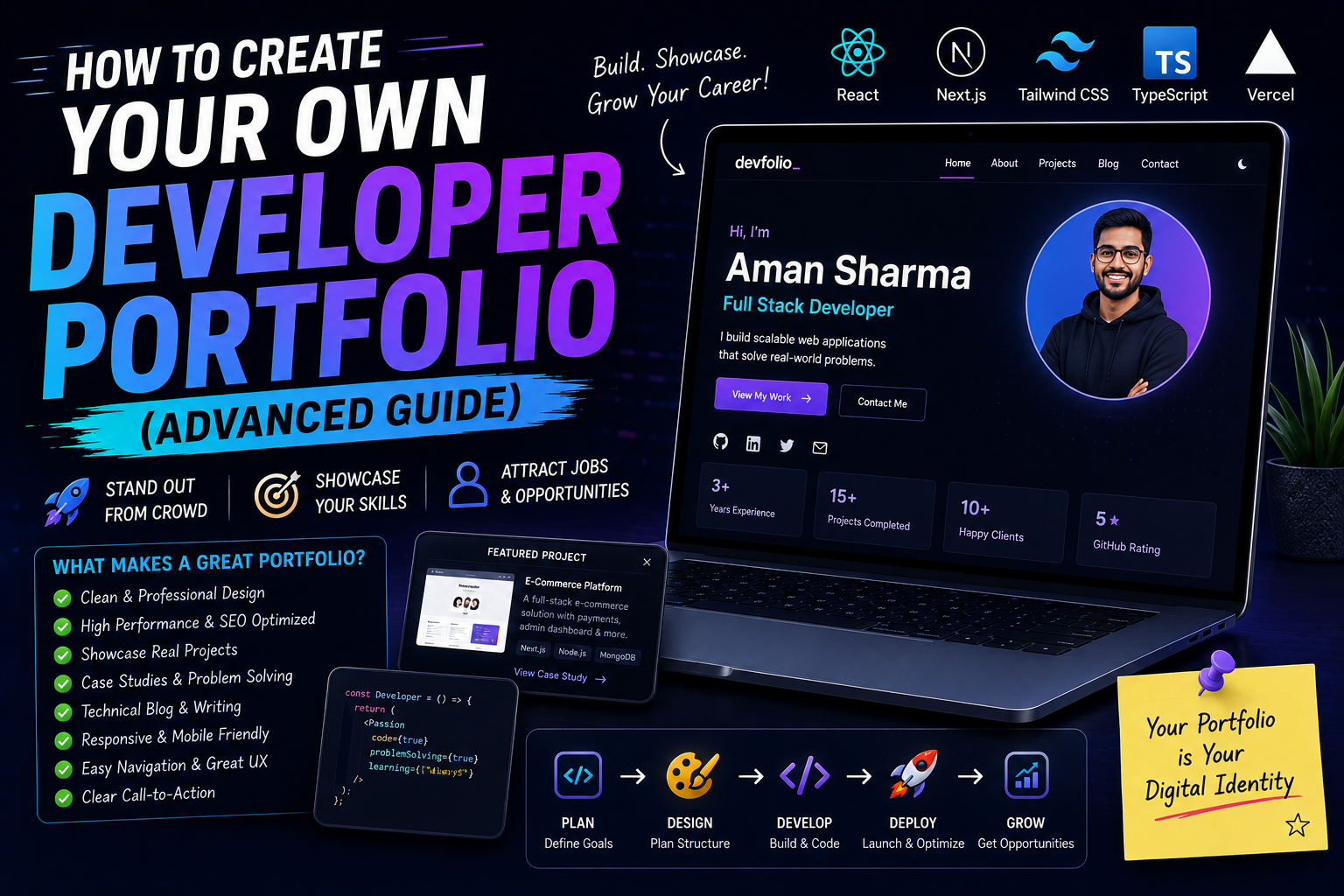
A few years ago, I figured a developer portfolio was basically this big fancy thing, like a dark themed website with a couple animations, a photo, and some kind of list of projects.
Yeah , i spent actual days tuning gradients, fiddling with hover effects, and polishing loading animations.
And what happened?
Nobody cared. Like really, not a single person.
The site looked honestly impressive too.
But the traffic… was basically zero.
Recruiters didn’t get in touch.
Clients didn’t message me.
Even potential collaborators, the ones I expected to notice, just weren’t interested.
That experience taught me something pretty direct :
A portfolio isn’t really a design task.
It’s a business asset.
Once I understood that, everything flipped.
I stopped thinking about stuff like:
“How can I make this look cool?”
And started asking:
“How can this site prove I solve real problems?”
That’s when portfolio development stopped being boring and started feeling… sharp and useful.
Because an advanced developer portfolio isn’t about showing code.
It’s about showing credibility.
It’s your personal brand, your resume, your case study archive and your proof of work, plus your digital identity.
All mashed together into one coherent place.
And in this world right now, where tons of developers already have GitHub accounts and very similar skill stacks, the portfolio is often the deciding factor.
I’ve gone through countless portfolios over the years.
Some looked amazing, but there was no real substance behind them.
Others were simpler, yet they made me trust the developer right away.
The difference wasn’t the technology, or any specific framework magic.
The difference was communication.
This piece is basically everything I wish someone had told me before I built my first serious developer portfolio.
Not just how to build it.
But also why most portfolios fail.
Why some actually work.
And how to create a portfolio that helps your career, instead of turning into that one more forgotten side project people never revisit.
Why This Topic Matters More Than Ever
The developer market has changed dramatically.
Ten years ago, simply knowing how to code was impressive.
Today?
Thousands of developers know:
- React
- Node.js
- Next.js
- TypeScript
- Python
Technical skills alone are no longer enough.
People need evidence.
They need proof.
When someone visits your portfolio, they’re asking questions:
Can this person build real products?
Can they solve problems?
Can they communicate clearly?
Can they finish projects?
Can I trust them?
A strong portfolio answers these questions quickly.
A weak portfolio leaves visitors confused.
And confused people rarely take action.
My Experience: The Portfolio That Nobody Visited
One of my earliest portfolios was visually impressive.
At least I thought so.
It had:
- particle effects
- complex animations
- fancy transitions
- custom cursor
- loading screen
The problem?
It was slow.
The content was weak.
The projects were poorly explained.
Visitors spent more time watching animations than understanding what I actually did.
That realization hurt slightly.
Because I had invested weeks into features that didn’t matter.
Eventually I rebuilt everything from scratch.
Simpler.
Cleaner.
More focused.
Results improved almost immediately.
Not because the design became better.
Because communication became better.
The Biggest Portfolio Mistake Developers Make
Most developers build portfolios for themselves.
Not for visitors.
This creates problems.
We focus on:
- technology stack
- animations
- design trends
Visitors care about:
- results
- experience
- projects
- credibility
There’s a huge difference.
A recruiter doesn’t care that your navbar uses advanced animation libraries.
They care whether you can contribute effectively.
A startup founder doesn’t care about your custom cursor.
They care whether you can solve business problems.
The portfolio should reflect that reality.
What Makes an Advanced Portfolio Different?
An advanced portfolio goes beyond:
“Here are my projects.”
Instead it communicates:
“Here’s how I think.”
“Here’s how I solve problems.”
“Here’s why my work matters.”
That distinction is huge.
Anyone can display screenshots.
Advanced portfolios tell stories.
Think Like a Product Builder, Not a Designer
This mindset changed everything for me.
Treat your portfolio as a product.
Every section should answer a question.
Homepage:
Who are you?
Projects:
What can you build?
About page:
Why should people trust you?
Contact page:
How can they reach you?
Simple structure.
Powerful impact.
Biggest Mistakes I Made
Writing Generic Project Descriptions
This mistake appears everywhere.
Example:
“Built an e-commerce website using React and Node.js.”
Okay.
But what problem did it solve?
What challenges existed?
What did you learn?
Generic descriptions create generic impressions.
Now I explain:
- problem
- approach
- challenges
- outcomes
Much more valuable.
Showing Too Many Projects
I used to believe more projects meant stronger credibility.
Wrong.
Twenty average projects are less impressive than three exceptional ones.
Quality wins.
Almost every time.
Ignoring Performance
This is ironic.
Developers build portfolios to demonstrate skill.
Then create websites that load slowly.
Portfolio performance matters.
Especially for developers.
People notice.
The Structure of an Advanced Portfolio
Let’s discuss practical architecture.
Homepage
The homepage should immediately communicate:
Who you are.
What you do.
Why it matters.
Visitors should understand this within seconds.
Not minutes.
Avoid complicated introductions.
Clarity beats cleverness.
About Section
Most developers underestimate this page.
People hire people.
Not technologies.
Talk about:
- journey
- experience
- interests
- goals
Make it human.
Real stories build trust.
Projects Section
This is usually the most important part.
But don’t simply show screenshots.
Explain:
Problem
What challenge existed?
Solution
How did you approach it?
Technology
What tools did you use?
Lessons
What did you learn?
This transforms projects into case studies.
Case studies are powerful.
Technical Blog Section
One of the smartest additions to modern portfolios.
Why?
Writing demonstrates:
- expertise
- communication
- consistency
A developer who can explain concepts clearly becomes significantly more valuable.
Honestly, technical blogging helped my credibility more than several projects combined.
Practical Example
Lets compare two portfolio entries, just real quick.
Weak:
Built a task management app using React.
Strong:
Built a task management system, designed to help remote squads track project progress. Implemented sign-in, real time updates ,and role based access rules. Picked up valuable lessons about state governance and WebSocket style architecture .
Same project
Different perception.
Advanced Features Worth Adding
Many developers add features that look impressive but provide little value.
Here are features I actually think matter.
Project Case Studies
Probably the most valuable feature.
Show:
- challenges
- decisions
- outcomes
This demonstrates thinking.
Not just coding.
GitHub Activity Integration
Useful when relevant.
But don’t rely on contribution graphs alone.
Context matters more than commit counts.
Testimonials
If available, absolutely include them.
Social proof is powerful.
Even a few genuine testimonials can increase credibility significantly.
Analytics
Interesting observation.
Most developers never analyze portfolio visitors.
Install analytics.
Learn:
- most viewed pages
- traffic sources
- visitor behavior
Data reveals opportunities.
Common Beginner Mistakes
Copying Famous Portfolios
This happens constantly.
Developers copy:
- layouts
- designs
- interactions
And lose individuality.
Inspiration is useful.
Copying isn’t.
Making Everything About Technology
Technology matters.
Results matter more.
Visitors care about outcomes.
Not only tools.
No Clear Call-to-Action
After viewing your portfolio, what should visitors do?
Contact you?
Hire you?
View projects?
Subscribe?
Guide visitors clearly.
SEO for Developer Portfolios
Many developers ignore SEO completely.
Huge mistake.
Your portfolio can attract:
- recruiters
- clients
- founders
- collaborators
Organic search matters.
Optimize:
- titles
- metadata
- URLs
- content structure
Visibility compounds over time.
Personal Branding Matters
This topic used to make me uncomfortable.
It felt self-promotional.
Eventually I realized:
Personal branding simply means helping people understand who you are.
That’s all.
Your portfolio should communicate:
- expertise
- values
- interests
- strengths
Authentically.
Not artificially.
What I Learned After Multiple Portfolio Rebuilds
A few lessons became obvious.
Simplicity Wins
The best portfolios I’ve seen aren’t always the flashiest.
They’re usually the clearest.
Visitors quickly understand:
- who
- what
- why
Clarity scales.
Storytelling Matters
Projects alone aren’t enough.
People remember stories.
Explain:
- struggles
- failures
- decisions
This creates connection.
Real Work Beats Tutorial Projects
Nothing damages credibility faster than portfolios filled entirely with clones.
Netflix clone.
Twitter clone.
Spotify clone.
Build something original.
Even small original projects often feel more impressive.
Future of Developer Portfolios
AI is changing software development rapidly.
Code generation becomes easier.
Templates become easier.
Standing out becomes harder.
That means portfolios will increasingly need to demonstrate:
- problem-solving
- creativity
- communication
- business understanding
Not just technical skills.
Developers who combine technical expertise with clear communication will have huge advantages.
Real Advice I Wish Someone Told Me Earlier
Stop trying to impress everyone.
Focus on helping the right people understand your value.
That’s a different goal.
Another important lesson:
Your portfolio is never finished.
Mine certainly isn’t.
It evolves continuously.
Projects change.
Experience grows.
Goals shift.
Treat your portfolio like a living product.
Not a one-time project.
Frequently Asked Questions
Should developers build portfolios from scratch?
If possible, yes.
Especially advanced developers.
It demonstrates technical ability.
That said, execution matters more than framework choice.
Is a portfolio necessary if I have GitHub?
Absolutely.
GitHub shows code.
A portfolio shows context.
Both serve different purposes.
How many projects should a portfolio contain?
Usually three to six strong projects outperform twenty average ones.
Focus on quality.
My Thoughts
A developer portfolio isn’t really about showing code.
It’s about building trust.
Trust that you can:
- solve problems
- communicate clearly
- finish projects
- create value
The strongest portfolios achieve this naturally.
They don’t scream for attention.
They demonstrate competence.
And honestly, that’s much more powerful.
Over the years, I’ve realized the best portfolios feel less like resumes and more like stories.
Stories about learning.
Building.
Failing.
Improving.
Creating.
That’s what people connect with.
