A few years ago I remember spending weeks learning this particular technology, because it felt like everyone on YouTube was saying it was “the future.”
Then like, six months later, almost nobody was bringing it up.
That whole thing taught me something kinda important.
Technology changes fast.
Really fast.
Frameworks rise, then vanish.
Programming languages get popular. Then another one takes the spotlight again.
Tools evolve. Workflows evolve. Entire industries do the same.
And all the while, developers everywhere keep asking the same kind of question, over and over:
“What should I learn next?”
Honestly, I used to ask it constantly.
Especially during the times when I felt stuck and sort of blocked.
I’d open LinkedIn.
I’d see people talking about AI, then cloud computing. Then cybersecurity, then Web3, then machine learning… then something else entirely.
And somehow it felt impossible to know where to put my attention.
The issue isn’t that there’s no information.
The issue is there’s too much information.
Everybody’s predicting the future.
But very few people explain how to think about the future, like in a real way.
That’s what makes this conversation interesting.
Because the skills that will matter in 2030 probably won’t just be specific tools, or exact frameworks.
They’ll be capabilities.
Ways of thinking.
Those adaptable technical foundations that stay useful even when today’s big shiny trend becomes tomorrow’s forgotten paragraph.
This piece isn’t about making perfect predictions.
Nobody can do that, not really.
Instead, it’s about figuring out which tech skills are most likely to create opportunities over the next several years, based on what we can already see happening.
And yeah, some of the answers surprised me too.
Why this topic matters more than ever
Honestly the whole technology industry feels bit different now, than it did even like five years ago. AI keeps accelerating everything and you can see it in how quickly products come together. Automation is also changing workflows, not just “helping”, but kinda re-shaping the whole process. And remote work … it’s expanded opportunities globally, so more people can compete and collaborate across timezones. So yeah, competition is higher now.
The older strategy— you know, “learn one technology and stay comfortable forever” — doesn’t really work anymore.
Skills are aging faster now. It can sound scary at first, like, pretty threatening.
But there’s a different side to the story too.
Developers who keep learning, not occasionally but continuously, become insanely valuable. And that’s because companies aren’t only hiring technologies. They’re hiring people who can adjust, pivot, and learn new things without falling apart.
That distinction is huge, honestly.
My Experience : Chasing the Wrong Skills
Early on in my journey, I kept doing this thing where I chased trends. Not even like, oh just for a moment, but more like I couldn’t help it.
A new framework came up.
So I jumped into it, almost instantly.
Then a new technology started gaining attention, and yeah, I went after that too.
After that another trend surfaced.
And again, same pattern. I mean really, same.
So what happened in the end ? I ended up with a lot of shallow knowledge, and not much real depth. Like , I could talk about stuff, but I couldn’t actually build with it.
At some point I finally clicked with myself.
The developers I admired the most weren’t constantly hunting down every new trend they saw.
They had strong fundamentals, solid groundwork.
So when new technologies showed up, they adapted fast , because their base was already firm.
That realization changed how I approach learning completely, and honestly it made everything feel more grounded.
The Biggest Mistake Developers Make
Many developers ask:
“What language should I learn for 2030?”
That’s not the best question.
A better question is:
“What capabilities will remain valuable regardless of technology changes?”
Because technologies evolve.
Problem-solving remains.
Systems thinking remains.
Communication remains.
Architecture remains.
Those skills compound over time.
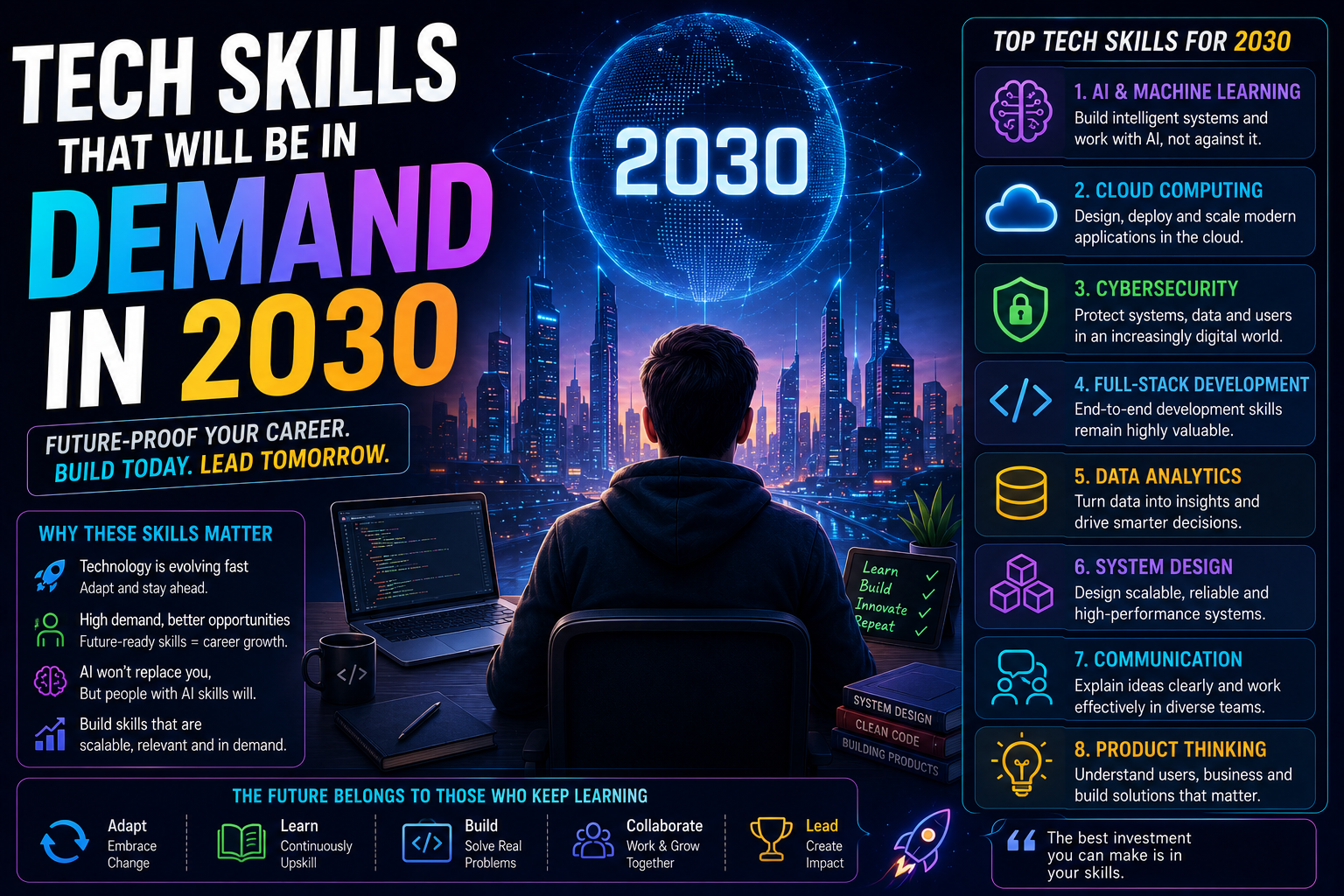
Skill #1: AI Collaboration
Lets talk about the obvious thing first
AI is not going away.
Whether developers like it or not AI-assisted development is slowly turning into normal stuff.
But where a lot of people get confused is the “future” part.
The valuable skill isn’t simply using AI.
Almost everyone will use AI anyway.
So the real advantage is collaborating with AI in a real way, like doing it properly, not just tapping a prompt.
And yeah this is different.
Developers who know how to
ask better questions, evaluate outputs validate results, integrate AI into workflows
Will get real major benefits.
I’ve already watched this play out.
Two developers can use the same AI tool.
One gets noticeably more productive.
The other one kinda stalls.
The tool itself isn’t the issue.
It’s the way they use it.
Skill #2: Problem Solving
This might feel kinda boring compared to AI stuff.
Still, I genuinely think it’s one of the safest bets for 2030.
Frameworks will change, programming languages will move forward.
But business problems? they stay.
Companies pay developers because problems exist, not because code exists.
Strong problem solvers keep beating developers who mostly memorize syntax.
This point took me a few years to really internalize.
Skill #3: Full-Stack Development
The whole definition of full-stack development keeps shifting over time.
Even so, knowing both frontend and backend is still extremely useful.
Why?
Because businesses keep valuing developers who understand the full system, end to end.
A developer who understands
- UI
- APIs
- databases
- deployment
- cloud infrastructure
Can contribute across different projects much more smoothly.
And no, that doesn’t mean everyone needs to become a master of absolutely everything.
But a wider mental model brings flexibility.
And flexibility turns into opportunities.
Skill #4: Cloud Computing
Cloud skills are not disappearing anytime soon.
If anything they’re becoming more important.
Modern applications lean hard on
cloud hosting, distributed systems managed services, and scalable infrastructure
Developers who understand cloud ideas gain a serious edge.
Not because every developer must become a DevOps engineer.
More because understanding deployment and infrastructure improves engineering decisions overall, like the tradeoffs feel clearer.
Skill #5: Cybersecurity Awareness
Notice I didn’t say “become a cybersecurity specialist.”
I said cybersecurity awareness.
Security is turning into everyone’s responsibility now.
Whether you’re building
- SaaS platforms
- startup products
- e-commerce systems
- mobile apps
Security still matters.
Developers who treat security like optional work keep creating real risks.
Knowing authentication, authorization encryption, and secure coding practices will stay valuable for the long haul.
Skill #6: Data Literacy
Data affects almost every decision modern businesses make.
Developers who understand
- analytics
- databases
- reporting
- metrics
Often make better product calls.
Also, this skill tends to get even more useful as AI grows.
Because data quality affects AI quality.
Bad data still makes bad outcomes, no matter how smart the model sounds.
Skill #7: System Design
This skill becomes more important the more experience you gain.
Early career, you mostly write code.
Later, architecture becomes the thing that matters.
Questions like:
- How should services talk to each other?
- How should data flow through the system?
- How should scaling actually work?
Start becoming more important as the years add up.
System design knowledge usually lasts longer than framework-specific knowledge.
Skill #8: Communication
This one catches a lot of developers off guard.
Communication consistently creates career advantages.
People who can explain clearly often
- lead teams
- shape decisions
- pull in clients
- lock in better opportunities
I learned this later than I should have.
At first, I assumed technical ability alone would decide everything.
The real situation is way more layered than that.
Communication amplifies technical ability, it doesn’t replace it.
Skill #9: Product Thinking
This skill separates builders from pure coders.
Product thinking means understanding
- user problems
- business goals
- customer behavior
Developers with product awareness tend to ship more valuable solutions.
Especially in startups.
Especially for founders.
Especially if you’re freelancing too.
Skill #10: Continuous Learning
Ironically, this might be the most future-proof skill of all.
Nobody knows for sure which technology will dominate in 2030.
But we do know technology changes.
Developers who keep learning adapt faster.
That’s the real advantage.
Not predicting the future perfectly.
Just adapting effectively.
Practical Example
Imagine two developers.
Developer A:
- memorizes one framework
- avoids change
- ignores industry shifts
Developer B:
- understands fundamentals
- learns continuously
- adapts to new tools
Five years later, who has better opportunities?
Usually Developer B.
Not because they’re smarter.
Because adaptability compounds.
Biggest Mistakes I Made
Focusing Too Much on Tools
I spent too much time worrying about:
- which framework
- which language
- which library
And too little time improving:
- architecture
- communication
- problem-solving
Tools matter.
Capabilities matter more.
Waiting for the “Perfect Skill”
Another mistake.
I wanted certainty.
The perfect roadmap.
The guaranteed future-proof technology.
It doesn’t exist.
Progress beats waiting.
Ignoring Soft Skills
Technical skills opened doors.
Communication helped keep them open.
This lesson became obvious later.
What I Learned
Several observations became clear over time.
Technology Cycles Repeat
New technologies feel revolutionary.
Many underlying concepts remain similar.
Learning fundamentals creates resilience.
Business Skills Matter
Developers who understand business problems often create greater impact.
Technical excellence matters.
Business awareness amplifies it.
Curiosity Creates Opportunity
Curious developers tend to discover opportunities earlier.
They’re willing to explore.
Experiment.
Learn.
That mindset matters.
Common Beginner Mistakes
Trying to Learn Everything
Impossible.
Technology is too large.
Focus matters.
Copying Other People’s Roadmaps
Your goals matter.
A startup founder needs different skills than a cybersecurity specialist.
Context matters.
Ignoring Fundamentals
Frameworks become easier when fundamentals are strong.
Never underestimate foundational knowledge.
Real Advice for Developers
If you’re planning for 2030, don’t obsess over predicting exact technologies.
Instead build strong foundations in:
- programming
- systems
- communication
- problem-solving
Then layer modern tools on top.
This strategy ages remarkably well.
Future Perspective
The most interesting thing about 2030 may not be which technologies dominate.
It may be how human skills and AI capabilities combine.
Developers will likely spend less time writing repetitive code.
More time:
- designing systems
- solving problems
- understanding users
- making decisions
That’s where long-term value seems to be moving.
Frequently Asked Questions
Will AI eliminate programming jobs by 2030?
Probably not in the simplistic way headlines suggest.
Roles will evolve.
Workflows will change.
Problem-solving remains valuable.
Which programming language should I learn for 2030?
Focus on learning programming concepts deeply.
Languages can change.
Concepts transfer.
Is web development still worth learning?
Absolutely.
Web technologies continue powering enormous portions of modern software.
My Thoughts
When people talk about the future skills, there’s this pull to chase certainty.
Like a guaranteed roadmap.
Like a perfect answer.
But technology… it rarely works like that, you know.
The folks most likely to do well by 2030 probably aren’t the ones who nail every single trend in advance.
They’re more often the ones who build adaptable foundations, step by step, even when things shift.
The ones who keep learning, not just once but continuously.
Also, the ones who blend technical expertise with communication, with real problem-solving , and with product thinking.
That seems to last longer than predictions.
And yeah, that’s kind of encouraging.
Because these abilities aren’t locked behind some secret door. They’re right there for anyone ready to practice them.
