Let’s be honest…
Every time we make an online payment, we trust the internet with our money.
Think about that for a second.
You enter:
- Card details
- UPI PIN
- OTP
- Bank info
…and somehow the payment goes through safely in seconds.
No cash.
No physical verification.
Still secure.
That’s actually kind of crazy.
And if you’ve ever wondered:
“How do online payments stay secure?”
then this blog is for you.
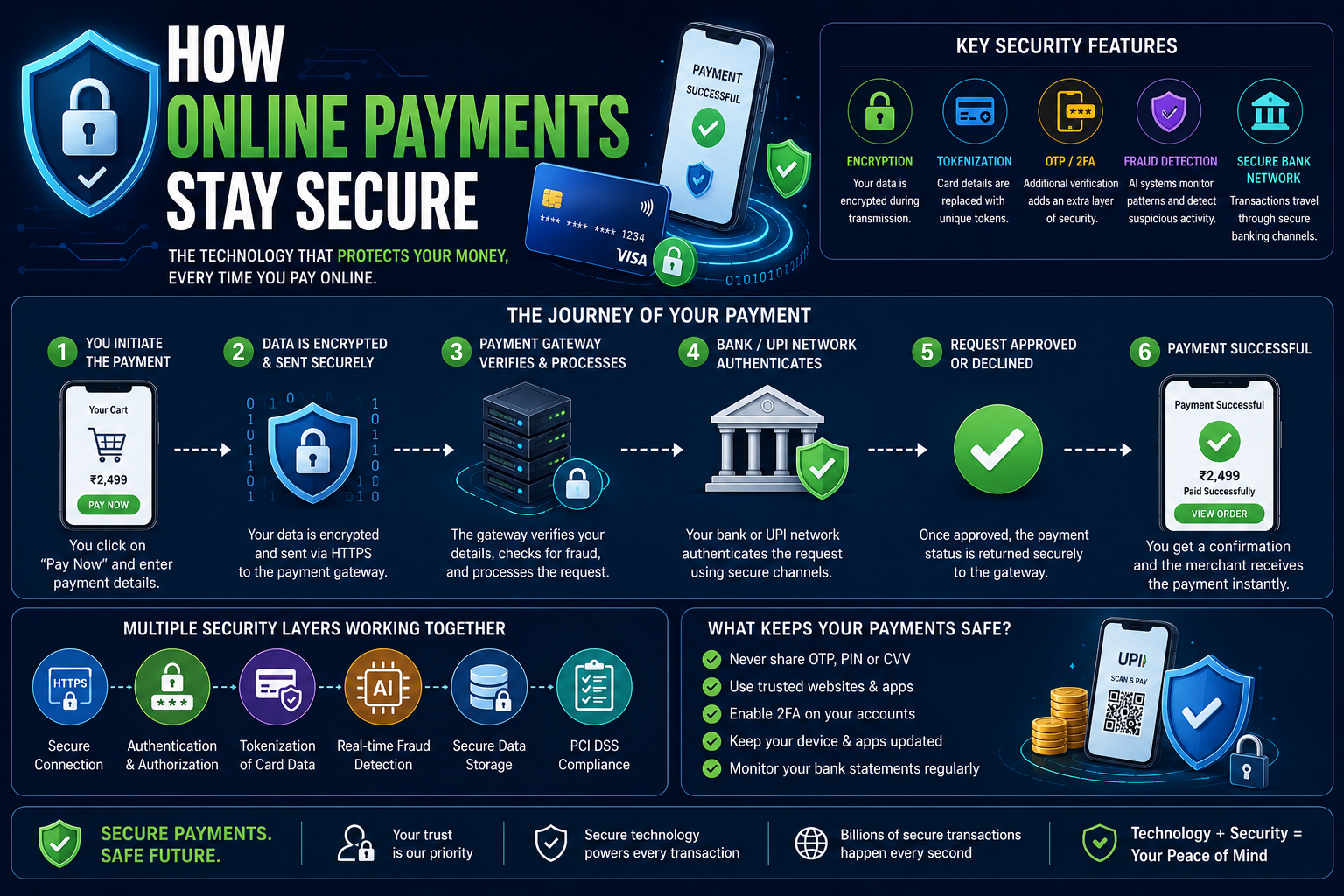
Because behind every successful transaction, there’s an entire security system working silently:
- Encryption
- Tokenization
- Fraud detection
- OTP verification
- Secure banking networks
- AI monitoring systems
And honestly?
The deeper I went into payment systems while building projects…
The more respect I developed for fintech infrastructure
So in this blog, I’ll explain how online payments stay secure — deeply, but in simple human language.
No boring banking theory.
Just practical understanding.
Why Payment Security Matters So Much
Imagine if payment systems were insecure.
What would happen?
- Money theft
- Card fraud
- Identity theft
- Fake transactions
The internet economy would collapse.
That’s why payment security is taken VERY seriously.
My Experience
First time I integrated online payments into a project…
I was focused on:
- Payment success
- UI
- API calls
But I ignored:
Security verification
Huge mistake.
Later I learned about:
- Webhook validation
- Signature verification
- Secure tokens
- Fraud checks
And that’s when I understood:
Payment systems are not just about sending money. They’re about building trust.
What Actually Happens During an Online Payment?
Before understanding security…
We first need to understand payment flow.
Let’s say:
You buy something online.
Step-by-Step Payment Flow
Step 1: User Clicks “Pay Now”
Could be:
- UPI
- Card
- Wallet
- Net banking
Step 2: Payment Request Created
System generates transaction request.
Includes:
- Amount
- Merchant ID
- Order ID
Step 3: Secure Connection Established
This is where security begins.
Your browser/app uses:
HTTPS Encryption
What HTTPS Actually Does
It encrypts communication between:
- Your device
- Payment server
So hackers cannot read sensitive data.
Example:
Without encryption:
Card Number: 1234 5678could be intercepted.
With encryption:
A8#JX7@Q92L!Unreadable garbage to outsiders.
This Is Called Encryption
And it’s one of the biggest reasons online payments are possible.
End-to-End Security Layers in Online Payments
Now let’s go deep.
1. Encryption (The Core Security Layer)
This is foundation of payment security.
What Encryption Means
Convert readable data into secret unreadable format.
Only authorized systems can decrypt.
Two Main Types:
Data in Transit
Protected while traveling through internet.
Data at Rest
Protected while stored in servers.
Why Important?
Even if data intercepted…
It’s useless without decryption key.
2. Tokenization (Very Important)
This concept changed payment security massively.
Problem Earlier
Websites stored actual card details.
Dangerous
Solution: Tokenization
Instead of storing real card number:
System stores:
Secure random token
Example:
Real card:
4111 2222 3333 4444Stored token:
TXN_XYZ_8292Why This Helps
Even if database leaks:
Actual card details safe.
This Is Used By:
- Stripe
- Razorpay
- Apple Pay
- Google Pay
3. OTP Verification (Second Security Layer)
OTP = One-Time Password
Very common in India.
Why OTP Matters
Even if someone knows:
- Card number
- CVV
they still need:
Your OTP
This Adds:
Two-Factor Authentication (2FA)
Meaning:
Something you know + something you own.
Example:
- Card details
- Your phone access
Together required.
4. UPI PIN Security
UPI uses secure PIN verification.
Important Thing:
UPI PIN is NOT stored openly.
It’s encrypted securely inside banking systems.
That’s Why Apps Say:
“Never share your UPI PIN”
Because PIN = authorization.
5. PCI DSS Compliance (Big Industry Standard)
This sounds technical…
But it’s important.
PCI DSS Means:
Payment Card Industry Data Security Standard
Rules companies must follow to handle card data securely.
Includes:
- Encryption
- Secure servers
- Restricted access
- Monitoring
Big Payment Companies Follow This
Because security failures can destroy trust instantly.
6. Fraud Detection Systems (Mind-Blowing Part)
Modern payment systems use AI heavily.
Systems Analyze:
- Transaction amount
- Location
- Device
- Behavior patterns
Example:
You usually pay from Delhi.
Suddenly:
Transaction from another country.
System flags it suspicious.
That’s Why Sometimes Banks Block Transactions
It’s not random.
Fraud systems detected unusual activity.
7. Secure Payment Gateways
Payment gateways act as security middlemen.
Examples:
- Razorpay
- Stripe
- PayPal
Their Job:
- Secure transactions
- Verify authenticity
- Reduce fraud risk
Why Businesses Use Them
Building secure payment infrastructure independently is VERY difficult.
8. Webhook Verification (Developer Side)
This is important for backend developers.
What Are Webhooks?
Payment gateway sends server-to-server confirmation.
Example:
{
  "payment": "success"
}
Problem:
Attackers can fake requests.
Solution:
Signature Verification
Backend verifies webhook authenticity.
Huge Beginner Mistake
Trusting frontend success blindly
Never do this.
9. Secure Banking Networks
Banks communicate through highly secure systems.
Examples:
- NPCI for UPI
- Visa network
- Mastercard network
These Networks Use:
- Encrypted channels
- Authentication systems
- Secure routing
That’s why transactions are fast AND secure.
How UPI Payments Stay Secure
UPI deserves special mention because India transformed payments massively.
UPI Security Layers
Device Binding
UPI linked to your mobile device.
SIM Verification
Phone number verification required.
UPI PIN
Authorization needed.
Encrypted Banking Communication
Secure backend infrastructure.
NPCI Monitoring
Centralized oversight.
Interesting Thing
Apps like:
- PhonePe
- Google Pay
don’t actually “hold” your money.
Banks + UPI infrastructure handle actual transfer.
How Credit/Debit Card Payments Stay Secure
Card systems evolved massively over time.
Security Features:
CVV Verification
Extra card security layer.
Expiry Validation
Additional verification.
OTP / 3D Secure
Prevents unauthorized use.
Fraud Monitoring
AI-based analysis.
Modern Cards Are Much Safer Than Earlier
Because security layers increased significantly.
Real Problems Payment Systems Face
This is where real engineering begins.
1. Phishing Attacks
Fake payment pages.
2. Data Breaches
Database leaks.
3. Man-in-the-Middle Attacks
Intercepting communication.
4. Fake Payment Screenshots
Very common in India.
5. Account Takeovers
Compromised credentials.
Security systems constantly evolve because attackers evolve too.
Mistakes I Made (Learn From This)
1. Trusting Frontend Payment Success
Big mistake.
2. Ignoring Webhook Validation
Security risk.
3. Poor Error Handling
Confusing payment states.
4. Logging Sensitive Data
Dangerous.
5. No Retry Logic
Temporary failures became permanent issues.
What I Learned
After working around payment systems, these became my rules:
- Never trust client-side data
- Verify everything
- Security > convenience
- Log carefully
- Think like an attacker sometimes
And biggest lesson:
Online payment security is all about layers. No single system protects everything alone.
Real Advice (If You’re Building a Product)
If your startup handles payments:
Learn These Properly
- HTTPS
- Encryption basics
- Webhook verification
- Tokenization
- Authentication
Use Trusted Payment Gateways
Don’t try building custom payment systems early
Use:
- Razorpay
- Stripe
- PayPal
Focus On:
- Reliability
- Security
- User trust
Because trust is everything in payments.
Real-Life Scenario (Relatable)
Imagine building:
Course payment system for Uniqoor
Without Proper Security:
- Fraud risks
- Failed transactions
- User trust issues
With Proper Payment Security:
- Smooth payments
- Better reliability
- Strong trust
Huge business impact.
Future of Payment Security
This space is evolving rapidly.
Trends:
- Biometric authentication
- AI fraud detection
- Passwordless payments
- Face ID payments
- Behavioral security systems
Payments Are Becoming Invisible
But backend security complexity is increasing massively.
Final Thoughts
Online payments feel simple.
Tap. Pay. Done.
But internally…
An enormous security system activates instantly.
- Encryption
- Authentication
- Fraud detection
- Banking infrastructure
- Secure routing
- Verification systems
Everything works together in milliseconds.
And honestly…
Once you understand payment security deeply, you start appreciating how much engineering protects every tiny transaction.
