One of the biggest misconceptions developers have is this:
“If I build something cool, people will buy it.”
Honestly… I believed this too for a long time.
I used to think technical quality alone was enough.
Good UI.
Fast backend.
Modern stack.
Fancy dashboard.
Dark mode.
Animations.
Surely people would love it, right?
Wrong.
The internet is full of beautifully built digital products nobody cares about.
And that realization hurts a little when you’re a developer because we naturally become emotionally attached to things we build. We spend late nights fixing bugs, improving designs, optimizing APIs… then launch the product expecting excitement.
Instead:
- zero sales
- low traffic
- no engagement
- no feedback
Just silence.
I still remember checking analytics after launching one of my earlier products and feeling genuinely confused.
“Why isn’t this working?”
Technically the product was solid.
But eventually I understood something important:
People do not buy products because they are technically impressive.
They buy products because they solve painful problems clearly and quickly.
That one lesson changed how I think about digital products completely.
And honestly, this article is everything I wish someone had explained to me earlier before I wasted time building things nobody wanted.
Not fake “passive income” hype.
Not guru advice.
Not “build once and become millionaire.”
Real lessons.
Real mistakes.
Real observations from actually trying to build useful things online.
Because digital products can become life-changing.
But only when you stop building for yourself and start building for real users.
Why This Topic Matters More Than Ever
We’re living in a strange internet era right now.
Building became easier.
Selling became harder.
A few years ago, creating software required:
- teams
- funding
- infrastructure
- designers
- complicated deployment
Now one developer with a laptop can build:
- SaaS products
- templates
- AI tools
- digital resources
- automation systems
- courses
- APIs
That’s incredible.
But there’s also a downside.
Because building became easier, the internet became flooded with products.
Every day new:
- AI wrappers
- productivity apps
- Notion templates
- Chrome extensions
- startup tools
Appear online.
So the challenge today is not only:
“How do I build?”
It’s:
“How do I build something people actually care enough to buy?”
Huge difference.
My Experience: The First Product Nobody Bought
One of my biggest learning moments came from a product I genuinely believed would perform well.
I spent weeks polishing everything:
- UI
- authentication
- responsiveness
- animations
- dashboard systems
The product looked “startup-ready.”
But I barely talked to users before building it.
Classic developer mistake.
Launch day came.
Nothing happened.
A few visitors.
Almost no conversions.
No excitement.
At first I blamed marketing.
Then design.
Then pricing.
But eventually I realized the deeper issue:
The product solved a weak problem.
People didn’t urgently need it.
That experience honestly frustrated me a lot because as developers we often think effort automatically creates value.
It doesn’t.
Users only care about their own pain.
That realization completely changed how I approach product building now.
The Biggest Myth About Digital Products
The biggest myth is:
“People buy features.”
Not true.
People buy outcomes.
Nobody wakes up thinking:
“I want advanced dashboard analytics.”
They think:
- “I want to save time.”
- “I want more customers.”
- “I want less stress.”
- “I want clarity.”
- “I want convenience.”
This sounds simple, but understanding this deeply changes everything about product building.
Your product is not the goal.
The user’s desired transformation is the goal.
What Counts as a Digital Product?
Many beginners think digital products only mean SaaS apps.
Not true at all.
Digital products can include:
- templates
- UI kits
- ebooks
- courses
- APIs
- automation tools
- scripts
- SaaS products
- plugins
- Notion systems
- developer tools
- databases
- AI prompts
- digital assets
And honestly, smaller focused products often sell better than giant complicated systems.
That realization surprised me initially.
Why Most Digital Products Fail
This section hurts a little because I’ve personally made almost all these mistakes.
1. Building Without Validating
Probably the most common developer mistake.
We fall in love with ideas too quickly.
Then immediately start coding.
No validation.
No user conversations.
No demand testing.
I used to do this constantly because coding feels productive.
Validation feels uncertain.
But eventually I learned:
Validation before building saves massive time.
2. Solving Weak Problems
This matters more than UI, branding, or tech stack.
Weak problem = weak sales.
If users feel:
“Yeah this is mildly useful…”
Sales become difficult.
Strong products solve painful recurring frustrations.
For example:
- repetitive work
- confusion
- wasted time
- difficult workflows
- business inefficiency
Pain creates urgency.
Urgency drives purchases.
3. Trying to Build Massive Products Initially
Beginners massively overbuild.
I used to think:
“If I’m building a product, it should feel huge.”
So naturally I kept adding:
- dashboards
- analytics
- AI features
- admin systems
- notifications
Completely unnecessary.
Now I think differently.
Small focused products are powerful.
One useful workflow is enough.
4. Ignoring Distribution
This mistake destroys many products.
Developers often think:
“I’ll focus on marketing after launch.”
Bad approach.
Distribution should start before product completion.
You need:
- audience
- trust
- discoverability
- positioning
Without visibility, even strong products stay invisible.
What I Learned About Products That Actually Sell
Over time, a few patterns became very obvious.
Useful Beats Impressive
This lesson changed everything.
Users rarely care about technical complexity.
They care about usefulness.
A simple product solving annoying problems often outperforms sophisticated products solving weak problems.
That’s why boring businesses can become surprisingly profitable.
Specific Products Sell Better
Generic products struggle.
Specificity creates clarity.
For example:
- “AI productivity platform”
Feels vague.
But:
- “Invoice generator for freelancers”
Feels clear immediately.
Specific audiences buy faster because they instantly understand value.
Speed Matters
People buy products that save:
- time
- energy
- mental effort
Convenience is valuable.
Especially online.
If your product simplifies painful workflows, people notice quickly.
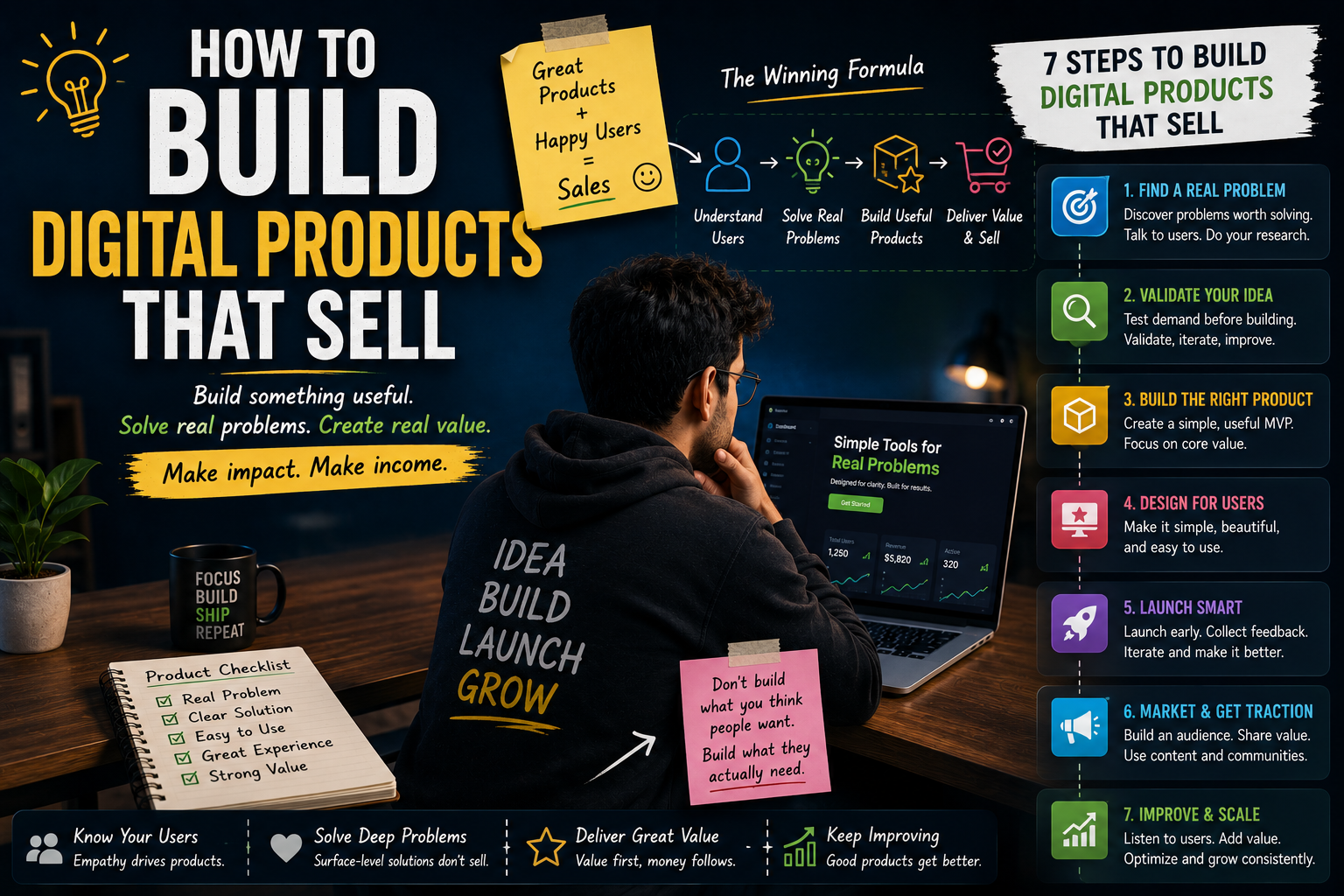
How to Build Digital Products That Sell
This is the practical framework I honestly wish someone had explained earlier.
Step 1: Start With a Real Problem
Not trends.
Not hype.
Not technology excitement.
Real frustrating problems.
The best product ideas usually come from:
- repeated annoyances
- inefficient systems
- manual repetitive work
- emotional frustrations
Pay attention whenever people say:
“Why is this still so difficult?”
That question often hides opportunity.
Step 2: Validate Before Building
Please don’t skip this.
Talk to people first.
Observe:
- complaints
- workflows
- existing solutions
- frustrations
And most importantly:
Check whether people already spend money solving this problem somehow.
Existing spending validates demand.
Step 3: Build the Smallest Useful Version
This lesson saved me huge amounts of time later.
Do not build the “full vision” immediately.
Instead ask:
“What is the smallest version solving the core problem?”
That’s your MVP.
Many successful digital products started embarrassingly small.
Step 4: Focus on One Clear Transformation
Your product should communicate:
- what it does
- who it helps
- what outcome users get
Clarity matters massively.
Confused users do not buy.
Step 5: Build Distribution Alongside Product
This changes everything.
Start:
- blogging
- posting online
- building audience
- sharing progress
- discussing problems
Before launch.
Attention compounds slowly.
Real-World Product Ideas That Work
Beginners often overcomplicate product ideas.
Here are realistic examples:
- resume builders
- niche templates
- productivity systems
- developer tools
- student comparison platforms
- automation scripts
- local business systems
- portfolio generators
- scheduling tools
Notice something important?
Most successful digital products solve practical problems.
Not fantasy startup concepts.
Common Beginner Mistakes
Chasing Trends Blindly
One month everyone builds AI products.
Next month everyone copies some SaaS trend.
Trend-chasing usually creates shallow products.
Build around problems instead.
Waiting Too Long to Launch
Perfectionism kills momentum.
I wasted ridiculous amounts of time polishing features nobody cared about.
Users reveal priorities faster than assumptions.
Launch earlier.
Ignoring User Psychology
This matters massively.
People buy emotionally first.
Then justify logically.
Good products reduce:
- stress
- confusion
- effort
- uncertainty
Emotional relief creates value.
The Emotional Side of Selling Products
This part deserves honesty.
Selling products online emotionally affects you.
Especially when:
- sales stay low
- launches fail
- users ignore features
- traffic drops
I’ve had moments where I questioned whether product building even made sense.
That emotional uncertainty is common.
The internet creates unrealistic expectations because everyone showcases success screenshots only.
Nobody posts:
- failed launches
- abandoned products
- zero-sale weeks
- burnout phases
But these things are normal parts of the process.
Practical Example: Building a Product That Sells
Let’s say you notice students struggling to compare institutes properly.
Bad approach:
Build giant AI education platform immediately.
Better approach:
Start smaller.
Maybe:
- searchable listings
- fee comparisons
- review systems
- inquiry workflow
Focused solution.
Specific audience.
Clear pain point.
Now selling becomes easier because value feels obvious.
Pricing Lessons I Learned
Pricing confused me badly initially.
I used to think:
“Lower price means more sales.”
Not always true.
Cheap pricing sometimes reduces perceived value.
Good pricing depends on:
- problem intensity
- audience type
- value delivered
- alternatives available
One thing I learned:
People pay surprisingly well for products saving time or reducing frustration.
Why Audience Matters More Than Beginners Think
This realization changed my perspective completely.
Founders with audience have huge advantages.
Audience creates:
- trust
- traffic
- feedback
- validation
- distribution
This is why content creation matters so much now.
Blogs.
Twitter/X.
LinkedIn.
YouTube.
Attention becomes leverage.
What Makes People Buy Digital Products?
A few emotional triggers matter consistently:
- clarity
- convenience
- urgency
- trust
- simplicity
- transformation
Users ask subconsciously:
“Will this make my life easier?”
That’s the real sales question.
Not:
“How advanced is the architecture?”
Future of Digital Products
AI is changing product building rapidly.
Soon almost anyone will create software quickly.
That means technical execution alone becomes less valuable.
What becomes more valuable?
- understanding users
- trust
- branding
- distribution
- storytelling
- niche focus
Human understanding becomes competitive advantage.
Technology changes fast.
Human frustrations stay surprisingly consistent.
Real Advice I Wish Someone Told Me Earlier
Stop trying to impress other developers.
Build for users.
Developers often admire:
- clean architecture
- advanced systems
- complex stacks
Users admire:
- simplicity
- speed
- usefulness
Huge difference.
Another important thing…
Do not wait for perfect confidence before launching.
Confidence usually appears after shipping repeatedly.
Not before.
And maybe the most important lesson:
You do not need one giant successful product immediately.
Several small useful products can completely change your journey over time.
Final Thoughts
Building digital products that sell is less about coding brilliance and more about understanding people deeply.
That realization changed everything for me.
Once you stop asking:
“What can I build?”
And start asking:
“What painful problem can I simplify?”
Product ideas become clearer.
Marketing becomes easier.
Sales become easier.
Because useful products naturally attract attention over time.
And honestly…
Some of the best digital products look surprisingly simple from outside.
That simplicity is often the result of deeply understanding users.
