One of the most painful feelings for a developer is this:
You spend weeks — sometimes months — building something you genuinely believe people will love…
And then absolutely nobody cares.
No users.
No feedback.
No excitement.
Just silence.
I’ve experienced this personally, and honestly, it hits harder than most people expect. Especially when you’re emotionally attached to the product. You convince yourself:
“This solves a real problem.”
“People definitely need this.”
“This can become huge.”
Then launch day comes.
Three visitors.
One signup.
Zero retention.
Suddenly you start questioning everything.
Was the idea bad?
Was the marketing weak?
Was the UI terrible?
Should I quit building startups completely?
The worst part is that many beginner founders think failure happened because they weren’t skilled enough technically.
But many times, the real issue starts much earlier.
They never validated the product before coding it.
And this mistake is unbelievably common among developers because coding feels productive. Validation feels uncomfortable.
Coding gives dopamine.
Validation gives uncertainty.
Talking to users feels awkward.
Asking questions feels slow.
Research feels boring.
So naturally we escape into building mode.
I used to do this constantly.
I’d open VS Code, design systems, dashboards, APIs, authentication flows… everything except the one thing that actually mattered:
“Do people truly want this?”
That single question can save months of wasted effort.
This article is basically everything I learned — painfully — about validating startup ideas before writing huge amounts of code. Not theory. Not fake startup guru advice. Real lessons from making wrong assumptions, getting emotionally attached to ideas, ignoring feedback, and slowly learning how real product validation actually works.
Because honestly… validation is less about protecting your startup.
And more about protecting your time, energy, motivation, and mental health.
Why Product Validation Matters So Much
Most developers think building is the hard part.
It’s not.
Building the wrong thing is the hard part.
A product can fail even with:
- good UI
- clean code
- fast performance
- modern tech stack
- impressive features
Because users don’t buy code quality.
They buy outcomes.
People pay for:
- convenience
- time-saving
- emotional relief
- clarity
- simplicity
- problem-solving
And if your product doesn’t solve something meaningful, coding harder won’t fix that.
This realization changed how I think completely.
Before validation, I used to approach projects emotionally:
“This idea feels exciting.”
Now I think differently:
“Is this painful enough for people to care?”
Huge difference.
My Experience: The Project That Taught Me Validation Matters
One of my earlier startup attempts taught me this lesson brutally.
I was obsessed with building a feature-rich platform because I thought more features automatically meant more value.
Classic beginner founder thinking.
I spent weeks building:
- authentication
- dashboards
- admin systems
- analytics
- user roles
- notifications
Honestly, technically it looked impressive.
But there was one problem.
I barely talked to actual users.
I assumed I understood the problem completely.
Big mistake.
After launch, engagement was terrible.
Users didn’t care about most features I spent time building.
Some workflows confused them.
Some things they simply didn’t need.
That moment hurt because emotionally I had already imagined success.
And when reality didn’t match expectations, motivation dropped heavily.
That experience forced me to rethink everything.
Now before building serious products, I focus heavily on understanding:
- user pain
- urgency
- behavior
- existing alternatives
- emotional frustration
Because once you deeply understand those things, product decisions become easier.
The Biggest Myth About Product Validation
Many beginners think validation means:
“Ask people if they like your idea.”
Wrong.
People are polite.
Friends especially.
If you ask:
“Would you use this app?”
Most people say:
“Yeah sounds cool.”
That means almost nothing.
Real validation is about observing behavior, pain, and urgency.
Not compliments.
This lesson took me too long to understand.
People saying:
“Nice idea bro”
is not validation.
People actively trying to solve the problem already?
That’s validation.
People paying for weak alternatives?
That’s validation.
People complaining repeatedly online?
That’s validation.
Behavior matters more than opinions.
What Product Validation Actually Means
Product validation simply means reducing uncertainty before investing major effort.
You’re trying to answer questions like:
- Is this problem real?
- Do enough people care?
- How painful is it?
- Are people already searching for solutions?
- Will users actually change behavior?
- Can this become sustainable?
That’s it.
Validation is basically reality-checking your assumptions.
Because founders are naturally biased toward their own ideas.
Very biased.
Biggest Mistakes I Made While Validating Products
Falling in Love With My Idea Too Early
This mistake destroys objectivity.
Once you emotionally attach yourself to an idea, you stop seeing flaws clearly.
You begin defending the product instead of understanding users.
I’ve done this many times.
Users would show confusion and instead of listening properly, internally I’d think:
“They just don’t understand yet.”
Dangerous mindset.
If users consistently feel confused, the product is the problem.
Not the users.
Building Before Researching
Developers love coding because coding feels like progress.
Research feels slow and uncertain.
So naturally many of us skip validation and jump straight into development.
I used to convince myself:
“I’ll validate after launch.”
Terrible approach.
Because after investing huge effort, your emotions make honest evaluation difficult.
You become attached to the product.
Asking the Wrong Questions
This one matters a lot.
Bad validation question:
“Would you use this?”
Better question:
“How are you solving this currently?”
The second question reveals actual behavior.
Real behavior matters more than hypothetical interest.
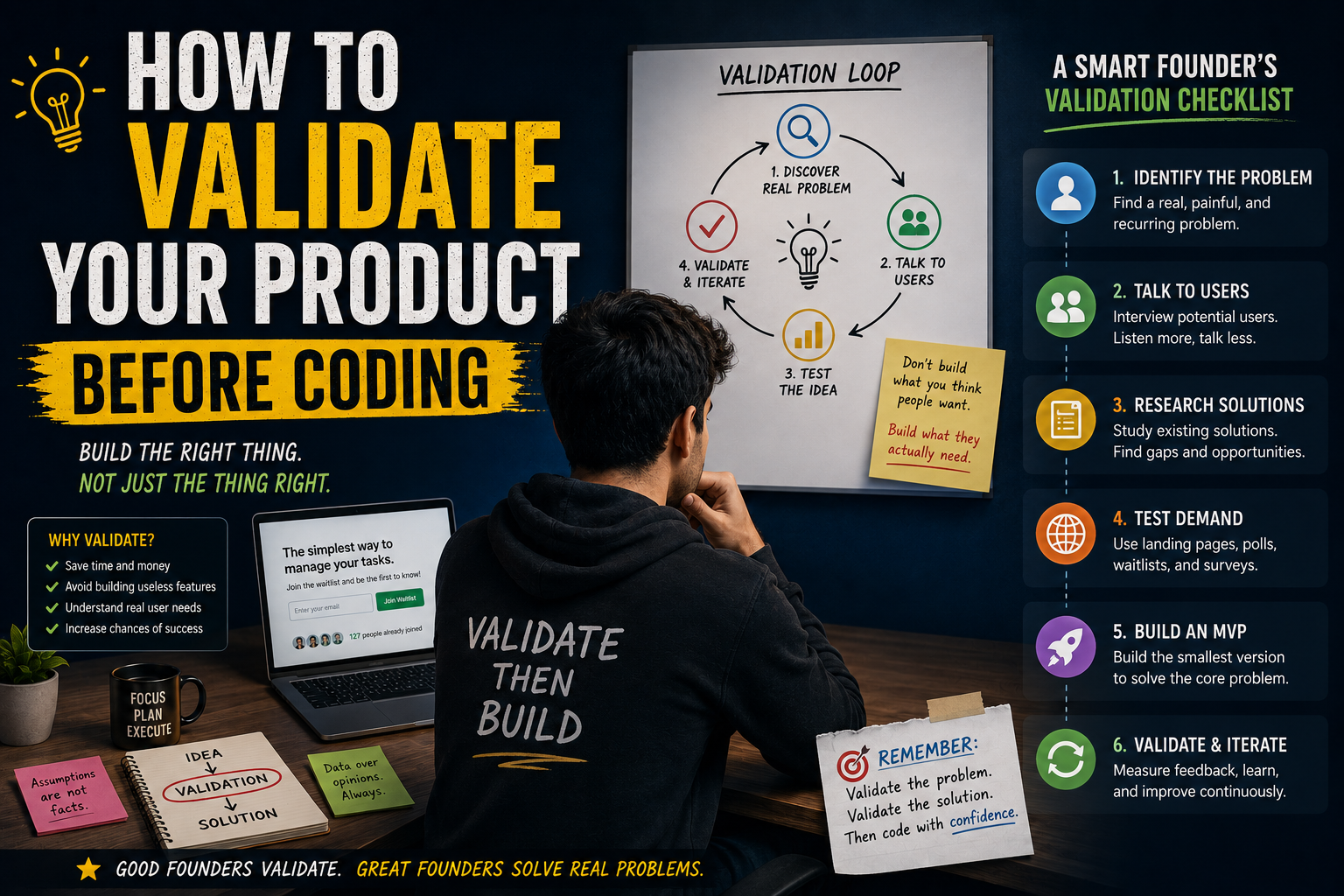
How to Validate a Product Before Coding
This is the practical framework I wish someone had explained earlier.
Step 1: Identify a Real Problem
Not a cool technology idea.
Not startup hype.
A real frustrating problem.
The best startup ideas usually involve:
- wasted time
- confusion
- repetitive tasks
- money loss
- emotional frustration
- inefficiency
For example:
- students struggling to compare institutes
- creators managing content manually
- businesses handling leads badly
- developers repeating workflows endlessly
Pain creates opportunity.
Weak annoyance usually doesn’t.
Step 2: Observe Existing Behavior
This step changed everything for me.
Instead of asking:
“Would people use my solution?”
Ask:
“How are people solving this right now?”
Because if users already:
- pay for alternatives
- use workarounds
- complain repeatedly
- spend time manually solving something
Then demand probably exists.
Even messy manual workflows indicate opportunity.
Step 3: Read Complaints Everywhere
This is underrated startup research.
Reddit is gold.
YouTube comments too.
Twitter/X.
Facebook groups.
Discord communities.
People openly complain about:
- bad tools
- missing features
- painful workflows
- expensive software
- confusing systems
I now treat complaints as startup research material.
Repeated frustration patterns reveal market gaps.
Step 4: Talk to Real Users
This feels uncomfortable initially.
But conversations reveal insights impossible to guess alone.
Ask:
- What frustrates you most?
- What wastes your time?
- What tools do you hate using?
- What’s confusing?
- What manual work feels repetitive?
And most importantly…
Listen carefully instead of pitching immediately.
Founders often talk too much during validation.
Good validation requires observation.
Step 5: Create a Simple Landing Page
This is one of the best validation techniques.
Before coding the actual product:
- create simple landing page
- explain the problem clearly
- show proposed solution
- collect emails
Now observe behavior.
Do people sign up?
Do they care?
Do they ask questions?
Real interest creates signals.
No interest also creates signals.
Both are useful.
Step 6: Test Demand Through Content
This approach works amazingly now.
Write:
- blog posts
- Twitter threads
- LinkedIn posts
- Reddit discussions
About the problem itself.
Observe reactions.
If people engage heavily with the problem discussion, demand may exist.
Content validation is underrated.
Step 7: Build the Smallest MVP Possible
Please don’t build the full vision immediately.
Beginners massively overbuild.
You do not need:
- advanced dashboards
- AI systems
- mobile apps
- complex architecture
You need one useful workflow.
That’s enough initially.
Validation becomes easier when development stays small.
Real-World Example of Product Validation
Let’s say you want to build a platform helping students compare institutes.
Bad approach:
Spend 6 months coding everything immediately.
Better approach:
- talk to students first
- understand confusion points
- ask parents about struggles
- study existing platforms
- validate search behavior
- create simple landing page
- collect interest
Now you’re reducing uncertainty before heavy investment.
This saves massive time.
Common Beginner Mistakes During Validation
Looking for Compliments Instead of Truth
This one is dangerous emotionally.
Beginners often seek encouragement instead of honest feedback.
But validation is not about protecting your feelings.
It’s about protecting your future time and effort.
Honest criticism is valuable.
Silence is valuable too.
Ignoring Negative Signals
Sometimes users clearly show low interest.
Founders ignore it because emotionally they want the idea to work.
I’ve done this myself.
When people repeatedly don’t care, pay attention.
Reality matters more than attachment.
Assuming Everyone Is the Target User
Not everyone needs your product.
That’s normal.
Specificity matters.
A focused niche often validates faster than broad audiences.
The Emotional Side of Validation Nobody Talks About
Validation feels uncomfortable because it challenges your assumptions.
And honestly… it hurts sometimes.
You become excited about an idea.
You imagine growth.
You picture success.
Then real users react with indifference.
That emotional disappointment feels personal initially.
But over time I realized something important:
Bad validation results are actually good outcomes.
Because discovering weak demand early saves enormous future frustration.
It’s much better to lose one week validating than lose one year building the wrong product.
That mindset shift changed everything for me.
What I Learned About Good Startup Validation
A few lessons became extremely clear over time.
Strong Problems Create Emotional Reactions
If users say:
“Yeah this is mildly annoying…”
Weak signal.
If users say:
“I hate dealing with this.”
Now attention becomes interesting.
Emotion matters.
Pain intensity matters.
Urgency matters.
Existing Competitors Are Not Bad
Beginners fear competition too much.
Competition often proves demand exists.
The real question is:
Can you solve the problem differently or better for a specific audience?
No competitors sometimes means no market.
That realization surprised me initially.
Validation Never Fully Ends
Even after launch, validation continues.
Every metric teaches something:
- retention
- user behavior
- engagement
- churn
- feedback
Good founders keep learning continuously.
Practical Validation Workflow I’d Use Today
If I started from zero today, here’s honestly what I’d do.
Week 1: Research the Problem
- read communities
- observe complaints
- study alternatives
- identify recurring frustrations
No coding yet.
Week 2: Talk to Users
- direct conversations
- surveys
- discussions
- understanding workflows
Focus on pain points, not features.
Week 3: Create Landing Page
Simple:
- problem
- solution
- waitlist
- CTA
Now measure interest.
Week 4: Build Tiny MVP
Only one useful workflow.
No feature overload.
Then launch quickly and observe behavior.
That’s it.
Simple process.
Massive difference.
Why Developers Struggle With Validation
Honestly, because coding feels safer emotionally.
Code follows logic.
Humans don’t.
Users are unpredictable.
Feedback can hurt.
Silence feels discouraging.
So developers naturally hide inside development.
I’ve done this too.
Building becomes emotional avoidance sometimes.
Validation forces reality.
And reality can feel uncomfortable.
But uncomfortable truth is better than comfortable delusion.
Future of Product Validation
AI is making software development faster every month.
Soon almost anyone will build apps quickly.
That means ideas alone become less valuable.
What becomes more important?
- understanding users
- identifying pain
- distribution
- trust
- validation
The ability to deeply understand human frustration will matter even more.
Because technology keeps changing.
Human problems evolve much slower.
Real Advice I Wish Someone Told Me Earlier
Don’t try validating through hype.
Validate through behavior.
And stop waiting for perfect certainty.
No startup idea comes with guaranteed proof.
Validation simply reduces risk.
It doesn’t eliminate uncertainty completely.
Another important thing…
Do not treat failed validation as personal failure.
Sometimes ideas simply lack urgency.
That’s normal.
Good founders move on faster instead of forcing weak demand.
That flexibility matters.
Note:
Most beginner founders think success starts with coding.
Honestly, success often starts before coding.
It starts with:
- observation
- conversations
- listening
- validation
- understanding pain deeply
Because once you solve meaningful problems, everything becomes easier:
- marketing
- messaging
- retention
- growth
Users naturally move toward useful solutions.
And maybe the biggest lesson I learned:
You are not trying to prove your idea is genius.
You are trying to discover whether people genuinely care enough for the product to exist.
That mindset changes product building completely.
