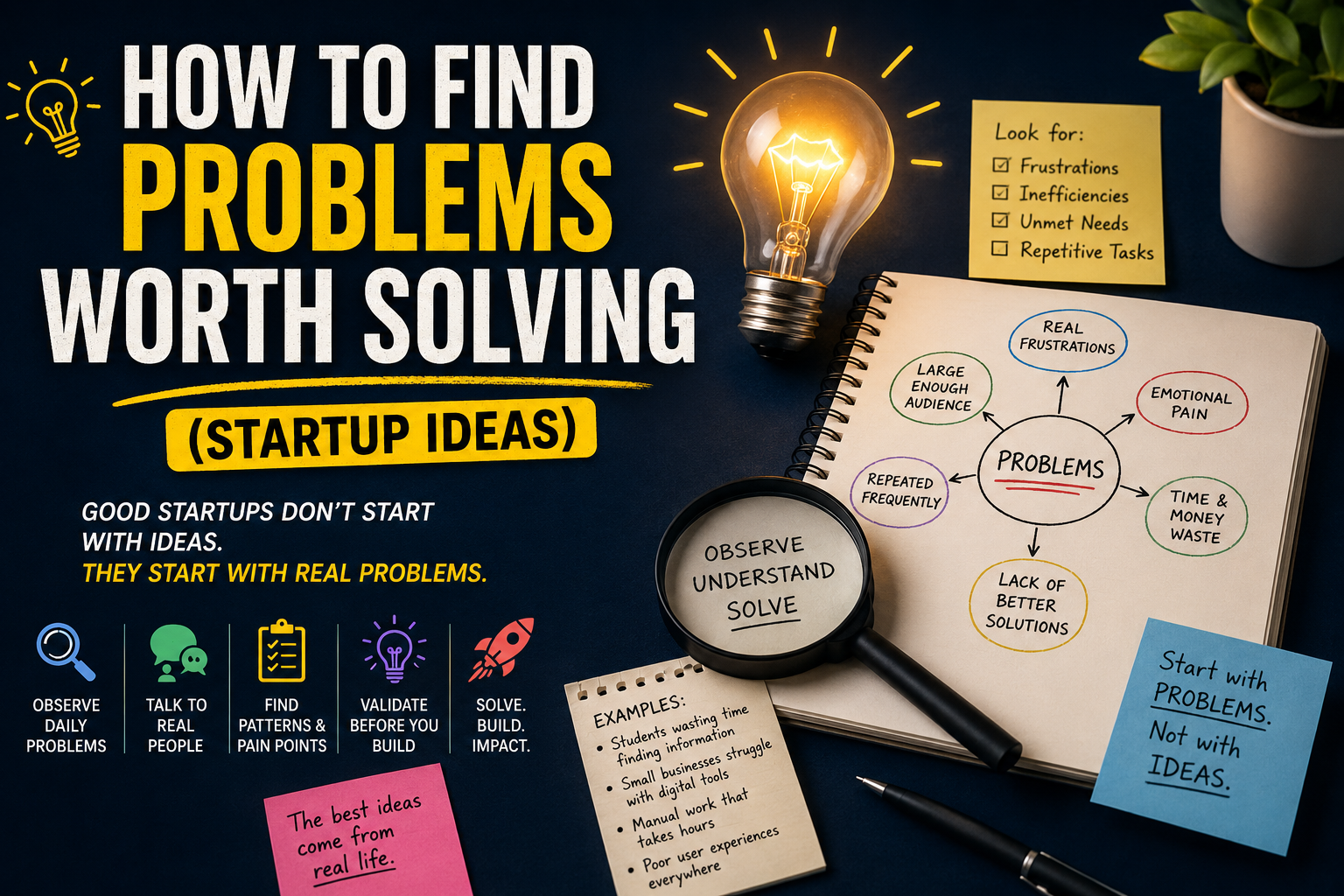
Every beginner founder thinks they need a “crazy unique startup idea.”
I used to think the same.
I would sit for hours watching startup podcasts, Shark Tank clips, YC videos, Twitter founder threads… and suddenly my brain would start forcing itself to invent the next billion-dollar company.
Nothing came out of it.
Just overthinking.
Sometimes I’d open Notion and write:
- AI app for students
- productivity tool
- social platform
- startup marketplace
- study app
- creator tool
Then after 10 minutes, every idea felt useless.
“Already exists.”
“Too competitive.”
“No one will use this.”
“Too difficult.”
“Requires funding.”
And honestly, this cycle mentally drains you after some time. Especially when you’re learning development and desperately want to build something meaningful.
The biggest thing I misunderstood back then was this:
Good startup ideas are usually discovered… not invented.
That realization changed how I look at business completely.
Most successful founders are not sitting in a dark room trying to magically brainstorm unicorn ideas. They notice frustrating problems, repeated inefficiencies, annoying workflows, broken systems, or emotional pain points that people already experience daily.
That’s where real startup ideas come from.
Not from motivation videos.
Not from random “top 10 startup ideas” lists.
Real startup ideas usually begin with irritation.
Something feels broken.
Something wastes time.
Something feels unnecessarily difficult.
And if enough people experience that same frustration repeatedly, there’s probably an opportunity hiding there.
This article is basically everything I wish someone had explained to me earlier. Not theoretical startup advice. Real observations from building things, failing at ideas, overthinking products, and slowly understanding how problems worth solving actually reveal themselves.
Because finding startup ideas is less about creativity… and more about learning how to observe the world differently.
Why This Topic Matters More Than People Think
Most beginner developers focus too much on coding skills and too little on problem selection.
That’s dangerous.
You can spend 8 months building a technically impressive product that nobody actually needs.
I’ve done this.
And trust me, nothing kills motivation faster than launching something people completely ignore.
No users.
No feedback.
No excitement.
Just silence.
At first you think maybe the UI is bad.
Then maybe marketing is weak.
Then maybe SEO is poor.
But sometimes the real issue is simpler:
The problem itself wasn’t important enough.
That realization hurts because developers become emotionally attached to their ideas. We think:
“I worked hard on this, so people should care.”
Unfortunately, users don’t care about our effort.
They care about their own pain.
That’s why finding problems worth solving is probably the most important startup skill nobody teaches properly.
A mediocre product solving a painful problem often performs better than a brilliant product solving nothing important.
The Biggest Lie Beginners Believe About Startup Ideas
People think startup ideas arrive like movie scenes.
Sudden inspiration.
Mind-blowing realization.
One perfect idea changing everything.
Reality is much messier.
Most good startup ideas initially look boring.
Seriously.
Some of the best businesses solve very ordinary problems:
- appointment scheduling
- invoices
- payment tracking
- study discovery
- shipping management
- form automation
- restaurant ordering
- inventory systems
Not glamorous.
But useful.
Beginners usually ignore boring problems because they want exciting startup ideas.
That was one of my biggest mistakes too.
I wanted ideas that sounded impressive instead of ideas that solved real pain.
Huge difference.
My Experience: The Moment I Started Understanding Real Problems
One thing I noticed during my own journey was this:
Whenever I built projects based on assumptions, they usually failed.
Whenever I built around observed frustrations, users responded better.
For example, there was a phase where I kept trying random SaaS ideas because everyone online was building SaaS products.
AI dashboard.
Productivity system.
Automation tool.
Typical beginner founder phase.
But every idea felt disconnected from reality because I wasn’t experiencing those problems deeply myself.
Then later, while observing students and institutes around me, I noticed something repeatedly:
Students were struggling to compare institutes properly.
Information was scattered everywhere.
Fees unclear.
Facilities exaggerated.
Reviews unreliable.
Parents confused.
Students wasting time physically visiting places.
Now this felt real.
Not because some YouTube video suggested it.
Because I saw the frustration personally.
That emotional closeness changes how you think as a founder.
Suddenly you stop building “features.”
You start thinking about human problems.
That shift matters a lot.
The Best Startup Ideas Usually Come From These 5 Places
After observing many products, talking with people, and honestly making lots of wrong assumptions, I realized most valuable startup ideas come from predictable patterns.
1. Problems You Personally Experience Repeatedly
This is probably the best starting point.
If something frustrates you consistently, there’s a chance others feel the same.
The benefit here is huge because:
- you already understand the pain
- you understand the workflow
- you understand emotional frustration
- you can test solutions naturally
For example:
- slow college systems
- confusing study material discovery
- terrible local business visibility
- repetitive development tasks
- messy client communication
These things seem small initially.
But repeated small frustrations create startup opportunities.
One thing I learned is this:
Annoyance is valuable data.
Whenever you catch yourself saying:
“Why is this still so difficult?”
Pay attention.
That question often hides startup potential.
2. Problems People Constantly Complain About
This one changed how I browse the internet.
Now whenever I see people complaining repeatedly, my brain immediately notices patterns.
Reddit is gold for this.
Twitter too.
Even YouTube comments.
People openly discuss:
- bad software
- confusing workflows
- expensive tools
- missing features
- terrible experiences
And most beginners ignore this free market research.
I used to ignore it too.
Now I actively observe complaints because complaints reveal demand.
A frustrated user is often closer to paying for solutions than a happy user.
That realization helped me think more practically.
3. Manual Work That Feels Stupidly Repetitive
This is underrated.
Whenever humans repeat unnecessary tasks manually, there’s usually opportunity for automation or simplification.
For example:
- manually organizing files
- sending repetitive emails
- updating spreadsheets
- attendance systems
- invoice tracking
- lead management
Boring problems become profitable businesses surprisingly often.
But beginners skip these because they don’t sound “startup-like.”
Big mistake.
Real businesses are often built around saving time, not looking cool.
4. Industries Still Running Offline
This category has massive opportunities, especially in India.
There are still countless systems depending heavily on:
- paper work
- phone calls
- WhatsApp chaos
- physical visits
- scattered information
Education is one example.
Local services too.
Small businesses.
Medical systems.
Rental systems.
Whenever you see industries struggling with digital organization, there’s potential.
Especially in Tier 2 and Tier 3 markets where digital transformation still has huge gaps.
Most startup content online focuses only on Silicon Valley-style ideas.
Meanwhile real-world local problems remain unsolved everywhere.
5. Problems You Understand Better Than Others
This matters a lot.
Sometimes founders succeed not because the idea is revolutionary, but because they deeply understand the users.
A developer understands developer pain.
A student understands student pain.
A teacher understands teaching pain.
Your environment gives you unfair advantages.
The mistake many beginners make is ignoring their own surroundings while chasing global startup fantasies.
Sometimes your best startup idea is literally happening around you daily.
Biggest Mistakes I Made While Searching for Startup Ideas
Trying to Force “Unique” Ideas
I wasted so much time trying to invent something nobody had ever built before.
Terrible approach.
Most successful startups are not completely original.
They are:
- simpler
- faster
- cheaper
- more focused
- better targeted
Beginners overvalue originality and undervalue execution.
Falling in Love With Technology Instead of Problems
I used to choose ideas based on technologies I wanted to use.
“Let’s build something with AI.”
“Let’s use blockchain.”
“Let’s build with microservices.”
Wrong order.
Technology should support the solution.
Not become the reason for the startup.
This mistake causes many useless products.
Ignoring Real User Conversations
One painful truth:
Your assumptions are usually wrong initially.
Users behave differently than you expect.
I’ve had ideas where I thought:
“People definitely need this.”
Then after talking to actual users, I realized they barely cared.
Now I value conversations far more than brainstorming.
How to Actually Find Problems Worth Solving
This is the practical part I wish someone had explained properly earlier.
Step 1: Start Observing Frustration Daily
Most people experience problems and instantly forget them.
Founders observe them.
Tiny difference.
Massive impact.
Start noticing:
- delays
- confusion
- repetitive tasks
- unnecessary complexity
- poor experiences
- broken systems
Carry notes.
Seriously.
Whenever something annoys you or others, write it down immediately.
Ideas disappear fast.
Step 2: Talk to Real People
Not startup Twitter.
Not motivational videos.
Real people.
Students.
Teachers.
Freelancers.
Shop owners.
Developers.
Parents.
Creators.
Ask:
- What wastes your time most?
- What do you hate doing?
- What software frustrates you?
- What feels unnecessarily difficult?
Most valuable insights come from conversations, not brainstorming sessions.
Step 3: Look for Repeated Problems
One complaint means little.
Repeated complaints matter.
If many people struggle with the same thing repeatedly, that’s important.
Patterns reveal opportunity.
This is why communities are powerful research places:
- Discord
- Facebook groups
- YouTube comments
- Quora
- LinkedIn posts
People unintentionally reveal startup ideas daily.
Step 4: Validate Before Building
This lesson saved me later from wasting months.
Before building:
- explain the idea to people
- observe reactions
- ask follow-up questions
- understand current solutions
Sometimes users say they want something… but won’t actually use it.
That difference matters.
Interest and demand are not always same.
Step 5: Build Small First
Please don’t build full startup systems immediately.
Beginners massively overbuild.
First create:
- MVP
- landing page
- simple prototype
- small workflow
Then observe behavior.
Real feedback changes everything.
Common Beginner Mistakes While Looking for Ideas
Waiting for the “Perfect” Idea
This one wastes years.
There is no perfect startup idea.
Most successful ideas evolve over time.
Your first version will probably change massively anyway.
Start smaller.
Thinking Every Market Is “Too Competitive”
I used to think:
“This market already has big companies.”
But competition often validates demand.
The real question is:
Can you solve the problem differently or better for a specific audience?
Niche focus matters more than beginners realize.
Overcomplicating Solutions
Beginners love complexity.
Users love simplicity.
Simple products solving painful problems often win.
One useful feature can outperform giant complicated systems.
Real-World Example: How Startup Ideas Actually Emerge
Let’s say you notice students struggling to compare local institutes properly.
Now instead of instantly building a massive AI startup, you think step-by-step.
First observation:
Students lack centralized information.
Second observation:
Parents waste time visiting institutes physically.
Third observation:
Institute claims are difficult to verify.
Now patterns appear.
Then maybe you create:
- simple comparison platform
- searchable listings
- verified reviews
- inquiry system
Notice something important?
The startup idea evolved from observed frustration.
Not random brainstorming.
That’s how practical founders think.
The Emotional Struggle Nobody Talks About
Finding startup ideas can become mentally exhausting.
Especially when social media constantly shows:
- funding announcements
- startup success stories
- revenue screenshots
- “build in public” hype
You start feeling pressure to invent something massive quickly.
I’ve gone through phases where I questioned every idea immediately.
“Not scalable.”
“Too small.”
“Already exists.”
“Won’t make money.”
That mindset kills creativity.
Some of the best opportunities initially look ordinary.
You need patience to notice them properly.
And honestly… spending too much time consuming startup content can damage your thinking because you stop observing real life.
Real startup ideas usually exist outside startup Twitter.
What I Learned About Good Startup Ideas
A few lessons became very clear over time.
Good Problems Have Emotional Friction
People pay faster when frustration feels emotional.
For example:
- career confusion
- wasted time
- financial stress
- business inefficiency
- communication problems
Emotional pain creates stronger demand.
Small Niches Are Powerful
Beginners underestimate niche markets.
A focused product for a specific audience often grows faster than broad generic products.
Trying to help everyone usually helps nobody.
Distribution Matters More Than Idea Perfection
Even strong ideas fail without visibility.
This realization changed how I think completely.
Now whenever evaluating ideas, I ask:
“How will users discover this?”
SEO?
Communities?
Content?
Social media?
Referrals?
Without distribution, products disappear quietly.
Real Advice for Beginner Founders
Don’t obsess over becoming “innovative.”
Obsess over becoming useful.
That shift changes everything.
You don’t need revolutionary technology initially.
You need clear value.
Also…
Stop waiting to “feel ready.”
Most founders start confused.
Most developers learn while building.
You gain clarity through action, not endless planning.
Another important thing:
Your first startup idea probably won’t be your final successful one.
That’s normal.
Every project teaches:
- user behavior
- product design
- validation
- communication
- distribution
Those lessons compound.
Future Perspective: Why Problem-Finding Will Matter Even More
AI is making building easier.
That means execution barriers are dropping fast.
Soon almost anyone will build apps, websites, and software quickly.
So what becomes more valuable?
Problem understanding.
User understanding.
Distribution.
Human psychology.
The people who deeply understand real-world pain points will have major advantages.
Technology changes rapidly.
Human frustrations remain surprisingly consistent.
That’s why learning how to observe problems is becoming one of the most important founder skills.
As My Thoughts
If you remember one thing from this entire article, remember this:
Startup ideas are usually hiding inside frustrations people already accept as “normal.”
That’s where opportunities exist.
Don’t chase startup ideas like treasure hunts.
Observe life more carefully.
Listen to complaints.
Notice inefficiencies.
Pay attention to repeated pain points.
And most importantly…
Build around problems you genuinely understand.
Because when you deeply understand users, product decisions become easier, marketing becomes easier, communication becomes easier, and honestly… motivation becomes easier too.
You stop building random projects for validation.
You start building meaningful solutions.
That difference changes your entire founder journey.
