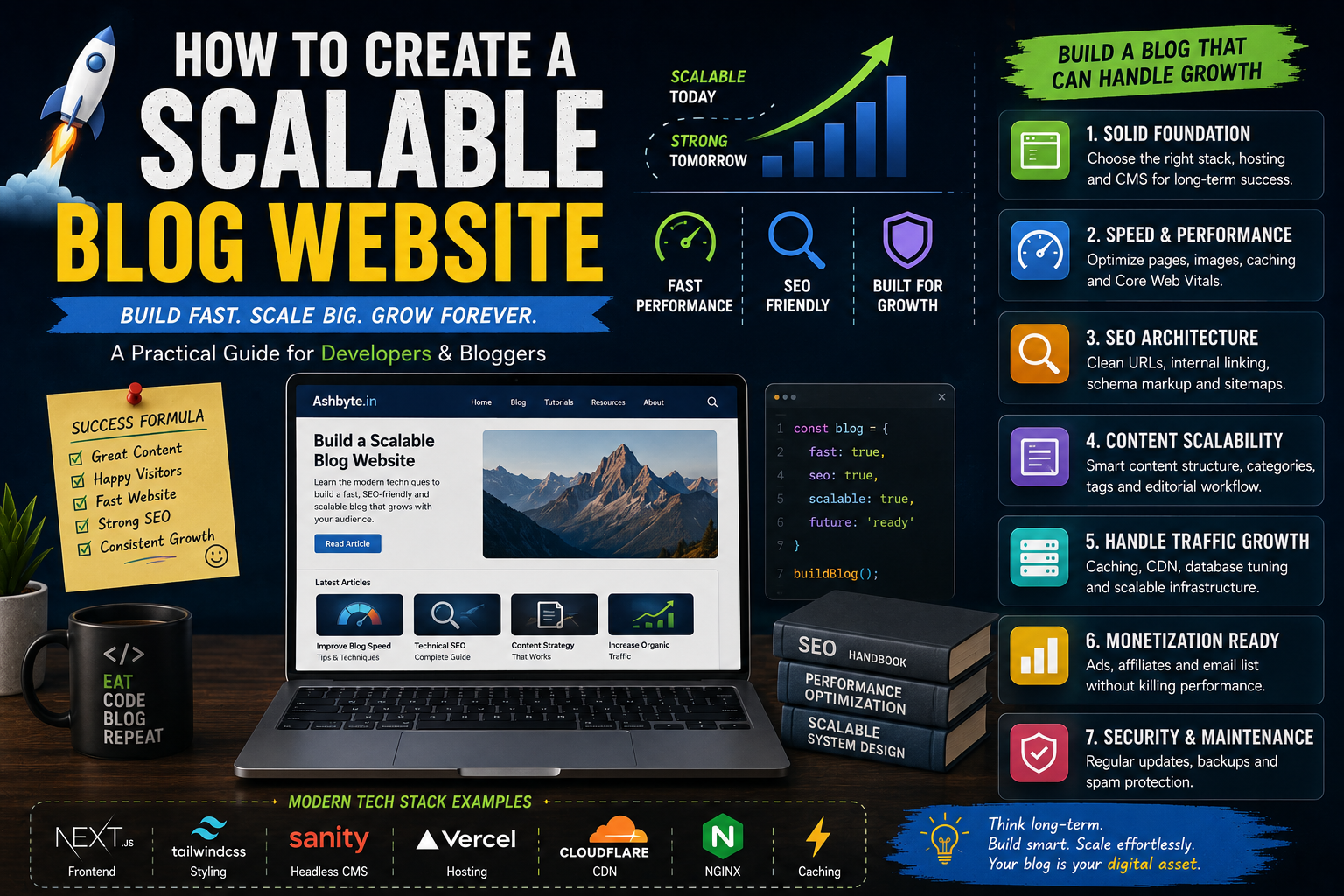
Most people think creating a blog website is easy.
Buy a domain.
Install WordPress.
Write articles.
Done.
Honestly… I used to think the same thing.
Then traffic started increasing.
Pages became slower.
SEO issues appeared.
Database queries became messy.
Hosting costs started rising.
Core Web Vitals dropped.
Ad scripts slowed everything down.
Spam comments exploded.
Mobile optimization became frustrating.
That’s when I realized something important:
Building a blog website and building a scalable blog website are completely different things.
And nobody really explains this properly to beginners.
The internet is full of “how to start a blog” tutorials, but very few people talk honestly about what happens when your blog actually starts growing.
Because growth changes everything.
A website that works perfectly with:
- 50 visitors/day
Can start breaking emotionally and technically at:
- 50,000 visitors/month
I’ve experienced parts of this journey myself while working on content-focused projects and observing how traffic, SEO, performance, user behavior, and infrastructure slowly become interconnected.
At first, you’re just happy seeing visitors.
Then suddenly you’re worrying about:
- page speed
- crawl budget
- image optimization
- server response times
- caching
- scalability
- monetization
- content systems
And honestly… it becomes overwhelming very quickly if your foundation is weak.
This article is basically everything I wish someone had explained earlier about creating scalable blog websites realistically — not textbook theory, not fake “10-minute blog setup” nonsense.
Real developer observations.
Real mistakes.
Real frustrations.
Real lessons.
Because a scalable blog website is not just about writing articles.
It’s about building a long-term digital asset that can grow without collapsing technically or mentally.
Why Scalability Matters More Than Beginners Think
When beginners create blogs, they usually focus on:
- themes
- colors
- logos
- homepage design
All understandable.
But scalability thinking starts differently.
You begin asking:
- Can this website handle traffic growth?
- Will pages stay fast later?
- Is content structure SEO-friendly?
- Can I manage hundreds of articles easily?
- What happens when monetization scripts increase?
- Will hosting survive traffic spikes?
These questions matter because blogs compound over time.
A good article can bring traffic for years.
That means if your blog succeeds, growth creates pressure naturally.
And honestly, many websites become difficult to manage simply because their foundation was never designed properly.
I learned this slowly after seeing how small technical shortcuts create huge headaches later.
My Experience: The “Everything Is Fine” Phase
One thing I noticed during my own blog-building journey was how deceptive the early stage feels.
Initially:
- pages load fast
- traffic is small
- hosting feels enough
- management feels easy
So naturally you think:
“This setup is perfect.”
Then slowly things change.
You add:
- more articles
- analytics
- ads
- plugins
- tracking scripts
- images
- SEO tools
- social integrations
Suddenly performance drops.
This phase frustrated me a lot initially because beginner tutorials rarely prepare you for scaling problems.
Especially on content-heavy websites.
I remember phases where I became obsessed with:
- Lighthouse scores
- Core Web Vitals
- image compression
- lazy loading
- database optimization
Not because I wanted perfection…
But because user experience and SEO started depending on these things.
That’s when I realized scalable blogging is partly content creation and partly systems engineering.
The Biggest Misunderstanding About Blog Websites
Most people think scalability only means:
“Can the server handle traffic?”
That’s only one small part.
Real scalability includes:
- content organization
- SEO structure
- performance
- monetization handling
- backend efficiency
- maintainability
- publishing workflow
- future flexibility
A scalable blog should:
- grow smoothly
- stay manageable
- remain fast
- support monetization
- adapt easily
Without becoming technical chaos later.
Why Most Blog Websites Become Slow and Messy
This section hurts a little because I’ve personally made several of these mistakes.
1. Plugin Overload
Classic beginner problem.
Especially with WordPress.
You install plugins for:
- SEO
- speed
- sliders
- analytics
- social sharing
- popups
- forms
- animations
Soon your website becomes bloated.
I’ve experienced this frustration personally because plugins feel convenient initially.
Then suddenly:
- performance drops
- conflicts appear
- updates break things
And debugging becomes exhausting.
Now I strongly believe:
Minimalism scales better.
2. Ignoring Mobile Optimization
Many developers test websites mostly on desktops.
Big mistake.
Most blog traffic now comes from mobile.
Slow mobile experience destroys:
- retention
- SEO
- user trust
I learned this after seeing pages that felt smooth on laptop but painfully slow on mid-range phones.
That realization changed how I test websites completely.
3. Poor Content Structure
This mistake quietly damages SEO.
Random categories.
Messy URLs.
Weak internal linking.
No topical organization.
Initially it feels harmless.
Later it becomes difficult to scale content properly.
Search engines love structure.
Users do too.
4. Ignoring Performance Until It’s Too Late
Beginners often think:
“I’ll optimize later.”
Dangerous mindset.
Performance issues compound over time.
Once a blog becomes huge, fixing structural problems becomes much harder.
Start clean early.
Future you will feel grateful.
What Makes a Blog Website Truly Scalable?
Over time, a few patterns became extremely obvious.
Fast Performance
Speed matters massively.
Not just for SEO.
For user psychology too.
Slow websites create frustration instantly.
Users leave silently.
And honestly… people are becoming less patient every year.
A scalable blog should remain fast even after:
- traffic growth
- monetization
- content expansion
Clean Architecture
Messy systems become stressful later.
Good structure includes:
- organized categories
- reusable components
- optimized database usage
- scalable CMS workflows
Clean systems reduce future headaches massively.
SEO-Friendly Foundation
A scalable blog is deeply connected to SEO.
Because traffic compounds through discoverability.
Important things include:
- internal linking
- semantic structure
- metadata
- URL consistency
- schema
- crawlability
SEO is not just “optimization.”
It’s architecture.
Content Scalability
This is underrated.
Can you comfortably manage:
- 100 articles?
- 500 articles?
- 1000 articles?
Many blogs feel manageable only while small.
Then publishing becomes chaotic.
Good content systems matter.
How to Create a Scalable Blog Website
This is the practical framework I honestly wish someone had explained earlier.
Step 1: Choose the Right Stack
This decision matters long-term.
For beginners:
- WordPress works well
- Next.js works well
- headless CMS setups work well
Depends on:
- technical skills
- customization needs
- scalability goals
Personally, I now prefer flexible systems giving strong performance control because speed and customization become increasingly important as traffic grows.
Step 2: Prioritize Performance From Day One
Please don’t postpone this.
Start with:
- optimized images
- lazy loading
- caching
- minimal scripts
- clean code
Performance debt becomes painful later.
Especially after monetization layers increase.
Step 3: Design Content Structure Properly
Think long-term.
Organize:
- categories
- tags
- URLs
- topic clusters
Before publishing hundreds of articles.
This improves:
- SEO
- navigation
- maintainability
Structured content scales better.
Step 4: Build Around SEO, Not After SEO
Huge beginner mistake:
Writing content first and “doing SEO later.”
SEO should influence:
- topic selection
- headings
- site architecture
- linking structure
Organic traffic compounds slowly but powerfully.
Especially for blogs.
Step 5: Create Reusable Components
This matters more for custom-built blogs.
Reusable:
- article layouts
- cards
- metadata systems
- sidebar structures
Save huge maintenance effort later.
Scalable systems avoid repetition.
Step 6: Optimize Media Properly
Images quietly destroy performance.
I learned this painfully.
Modern scalable blogs need:
- compressed images
- next-gen formats
- lazy loading
- CDN optimization
Media handling becomes critical as content expands.
Step 7: Think About Monetization Early
Ads can destroy performance badly.
Affiliate banners too.
Sponsored widgets.
Trackers.
Scripts.
All affect speed.
A scalable blog balances:
- monetization
- performance
- user experience
This balance matters massively.
Common Beginner Mistakes
Chasing Fancy Design Over Usability
This happens constantly.
People obsess over:
- animations
- effects
- complex UI
Meanwhile readability suffers.
Content websites should prioritize:
- clarity
- readability
- speed
- navigation
Users visit blogs mainly for information.
Not cinematic experiences.
Publishing Random Content
Scattered topics weaken growth.
Focused topical authority matters much more now.
Search engines reward expertise and consistency.
Ignoring Internal Linking
This quietly damages scalability.
Good internal linking:
- improves SEO
- increases engagement
- distributes authority
- improves crawlability
And honestly… many beginners ignore this completely.
Practical Example: Building a Scalable Tech Blog
Let’s say you’re building a tech blog like Ashbyte.in.
Weak approach:
Random articles across unrelated topics.
Better approach:
Create topic clusters like:
- startups
- web development
- SaaS
- AI tools
- developer growth
- SEO
Now content becomes interconnected.
This improves:
- authority
- user retention
- discoverability
Structure creates compounding effects.
The Emotional Side of Building Blogs
This part deserves honesty.
Growing blogs emotionally tests patience heavily.
Especially early on.
You publish articles…
Nothing happens.
You improve SEO…
Still low traffic.
You optimize pages…
Tiny growth.
This slow invisible phase frustrates many creators.
I’ve experienced phases where I questioned whether writing consistently even mattered.
Then suddenly older articles started ranking slowly.
That’s when blogging clicked for me.
Blog growth compounds quietly before becoming visible.
That delayed feedback makes blogging emotionally difficult initially.
What I Learned About Sustainable Blogging
A few lessons became extremely clear over time.
Consistency Beats Intensity
One viral article changes little long-term.
Consistent publishing compounds.
Especially in SEO.
Traffic growth often looks invisible before suddenly accelerating.
Simplicity Scales Better
Clean systems survive growth better.
Minimal plugins.
Clean layouts.
Focused categories.
Simple architecture creates fewer future problems.
Technical SEO Matters More Than People Think
Page speed.
Metadata.
Schema.
Indexing.
Crawlability.
These things quietly affect growth massively.
Especially competitive niches.
Audience Matters Too
SEO is powerful.
Audience is leverage.
Combining:
- blogging
- social presence
- email lists
Creates stronger growth systems.
Traffic sources should diversify over time.
Real Advice I Wish Someone Told Me Earlier
Don’t build blogs only for short-term traffic.
Build digital assets.
That mindset changes everything.
You stop chasing:
- random clicks
- shallow content
- quick hacks
And start focusing on:
- quality
- structure
- authority
- sustainability
Another important thing…
Avoid comparing your early traffic to established blogs.
That comparison destroys motivation fast.
Most successful blogs grew slowly initially.
Future of Scalable Blog Websites
AI-generated content is flooding the internet now.
This changes blogging massively.
Generic content will struggle more.
What becomes valuable?
- real experience
- original insights
- human storytelling
- niche expertise
- practical observations
Authenticity becomes competitive advantage.
And honestly… technically optimized websites with genuinely useful content will continue winning long-term.
Final Thoughts
Creating a scalable blog website is not only about development.
It’s about building systems capable of growing sustainably over time.
That includes:
- performance
- SEO
- architecture
- content strategy
- monetization balance
And maybe the most important lesson I learned:
A successful blog is usually built slowly.
Not through shortcuts.
Not through hacks.
But through:
- consistency
- optimization
- patience
- useful content
- smart structure
The compounding effect of blogging feels invisible initially.
Then one day you realize your old articles are still bringing visitors while you sleep.
That’s when scalable blogging starts becoming powerful.
